I’ve been thinking a lot about time lately. For all of my travels and nomadic lifestyle, more often than not, I wonder whether I’ve placed myself in the position of NOT showing up and being present for those I love and care about.
I live in Oklahoma. My son lives in Indiana. My family lives in Oklahoma. My girlfriend lives in Colorado. And my place of employment is based in Arizona- though much of my erstwhile work was mostly national and international in scope. Suffice it to say, it’s a lot to juggle and I live out of suitcases and backpacks more often than I’d like. A part of me longs for a place to call home.
Like many of you, I’ve done this for nearly a decade.
I heard a hymn long ago with a verse that says, “Time is now fleeting the moments are passing. Passing for you and for me.” That’s true. Every moment not spent in one place is spent in another. And once you string together enough moments, time passes by.
Time these days seems less about travel and more about presence.
In my life, I’ve often felt that life was such a hurry. A hurry to achieve – whether it be financial, career, or educational success. But I am learning, slowly, that the rush causes one to miss out on the things that are actually worth enjoying. As an old country music song put it, “I rush and rush until life’s no fun…but I’m in a hurry and don’t know why.”
And I wonder, what would be the harm in slowing down? To savor moments. To enjoy the journey as the Zen among us might suggest. Yet, this seems to be, among many things, one of the things I can’t seem to do. Rushing is second nature. On to the next thing, no matter how much I might try to savor the moment. At any given point, there are a million other moments competing for my attention, and I can’t for the life of me sort out why.
The reality is that none of my rushing matters. Clarity will come. Resolution will come. Satisfaction will come. Things will sort themselves out one way or another. All I can do is keep moving and wait.
The problem of time is that it moves so slowly when one would that it were fast. And it moves so quickly when one would that it were slow. If I were to rely upon the caprice of time, the result would be a perpetual state of malcontent – which, the years have taught me, is no way to live.
In this season of life, I feel that the best way to navigate the past and the road ahead is to slow down. I’ve rushed for so long and ventured so far from my moorings that it’s actually quite useful to take stock and see where my values lie.
The reality is that we don’t get a “do-over” in the life. It’s only one shot. And we have to make it count.
I’ve spent the past couple of weeks after my son’s birthday here in Indiana. We carry on with our routine as we always have. I wake him up. Sort his clothes. Make sure he gets on the bus. In the meantime, I cook him an egg.
The routine went okay this morning. He seemed a bit churlish. I think he had some issues falling asleep last night. But we did the things – he got dressed, I cooked the egg and he got on the bus fine. I do not know if this is the last breakfast I’ll cook him while I’m here. But it leaves me a bit wistful.
As he sat down to eat, it occurred to me that, someday, there will be a last egg. His preferences, like his body will grow and change. What is preferred today will no longer be preferred tomorrow. And then I will no longer be needed to cook the egg anymore. Nor will it be wanted. Another vestige of youth lost to anachronism.
That’s fine really. I don’t recall my last breakfast with my late grandfather. I just remember what a joy it was to have had them. And I think that’s the point of memory and of time. Not that I do the egg, but that I love him and showed up. Perhaps, if I’m lucky, through some miracle of memory, when he’s older he’ll remember that Dad came to Indiana sometimes and cooked the egg. I hope he remembers then how much I love him.
I will leave here on Sunday. Duty calls back home and points west. But a piece of my heart always stays here with him – as it should.
But man, I hope that last egg doesn’t come too soon.
I’m usually garbage at keeping New Year’s resolutions. I make them. Forget them. Vaguely recall them in early February. Make a half-assed effort to revive them. And by Valentine’s Day or so, I’ve completely given up. “New Year, New Me” lasts roughly six weeks.
And then I’m stuck with old me. Same habits. Fairly similar routine. A bit disappointed that the holiday season is all over with so long to go until it comes ‘round again. So, rather than go through the whole ordeal of creating a resolution and ditching it from start to finish, I’ve decided to do something this year that might actually be achievable. I’ve decided to adopt one simple philosophy to guide my decision making: this year, I choose joy.
To put a finer point on it, there are a million decisions each year, each day even. Some of them are real dilemmas. Some of them are just options to avoid responding in anger or disdain. Others are opportunities to avoid annoyance and focus on the positive. Whatever the situation, my goal is to choose the option that will bring joy into my life.
In point of fact, I think joy is something I’ve long underrated. I slipped into a habit over the years of putting joy on hold. I defer joy until later and hope that it works out. I put off the things that make me feel alive and promise myself that I’ll get around to them at some point. Practicality over passion. I focus on the negative or allow annoyance to creep in, and ignore a response that might actually allow for joy.
In short, I ignore joy when it’s easy, and that makes it much more difficult to come back around to it when it becomes a choice that’s hard. But life is full of tough choices. So, why not opt for those that add joy to my life, rather than subtracting joy from it?
I get that it’s a rhetorical question I’m asking myself at this point. Yet, it’s taken years to arrive at this conclusion. So, I count it progress. And what can we hope to achieve in a year if not progress?
So, welcome 2025. I have zero control over what you will bring. Good or bad. But I can control how I respond to all of the things. And this year, I choose joy.
I always feel a bit wistful once Christmas has passed. In the weeks leading up to the big day, I listen to Christmas music on repeat, make sure that the tree is decorated, and tend to the odds and ends of decorating the house to make sure that it’s appropriately festive – in addition to braving the crowds and finding the last minute gift that has invariably slipped my mind.
This year was no exception. I picked my son up from Indiana just a few days before the holiday. My girlfriend spent Christmas with our family for the first time. And the new place I’ve rented was bustling with activity and family more so than it ever has been. So, there were a lot of firsts this holiday. And in the rush to pull off the big event, I found it difficult to remain present and soak up the memories that were being made amid the chaos.
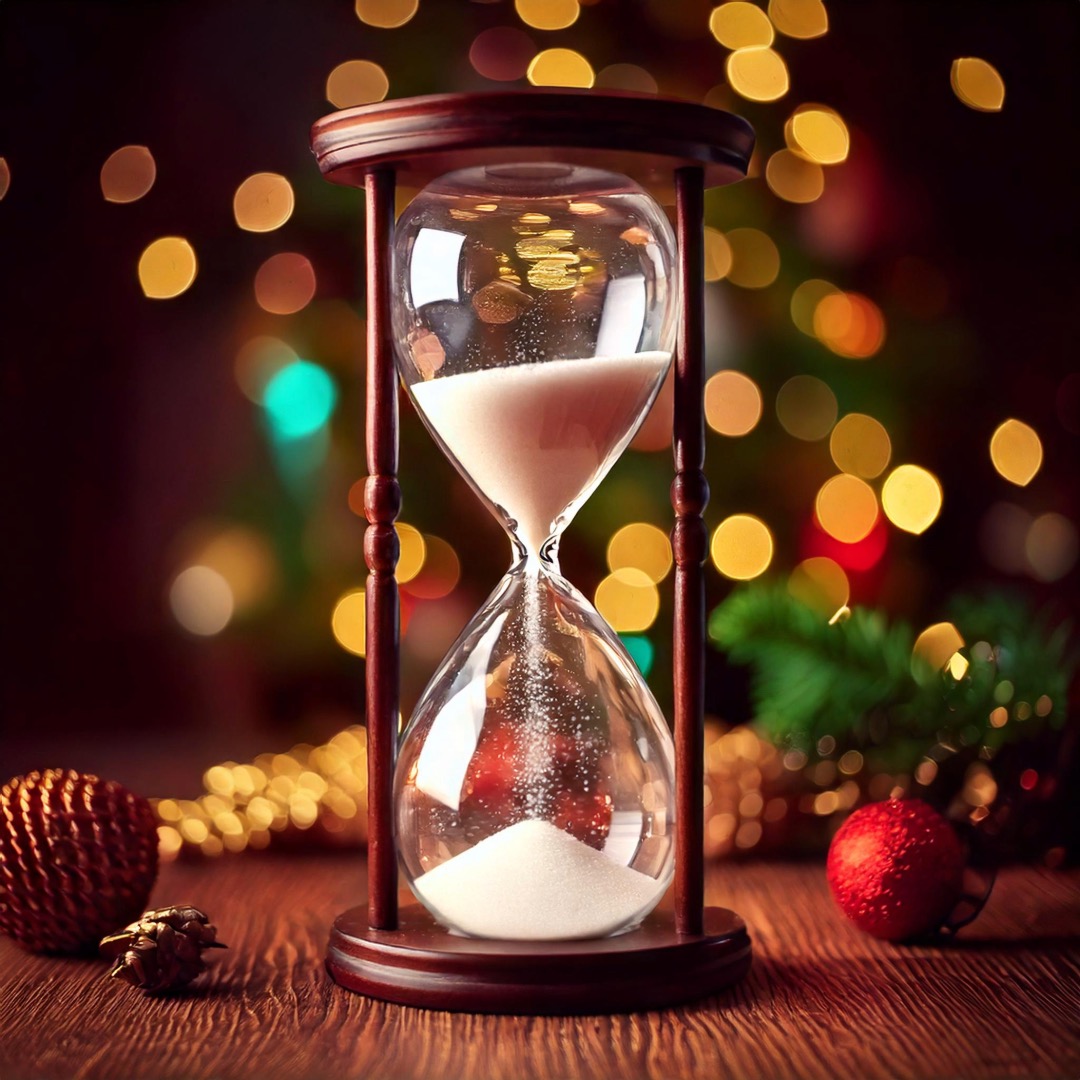
But that’s the funny thing about time. There’s no pause button. And time doesn’t care whether we were able to soak up the moments or not. Try though I might, I can’t grasp the sands of time and put them back atop the hour glass. They fall with a constant flow and the best we can do is appreciate the seconds as trickle away.
I suppose this is true of life more broadly. When I think about Christmas a year ago, I had no idea what the new year had in store. I came to OK from Indiana, rather than living here. And my girlfriend who joined us for the holiday, I didn’t know she existed. I suppose it’s true that I could have grasped at the sand but I wouldn’t have been able to appreciate all of the good that was still to come. So, while it’s not possible to hit pause on time, one wonders if it’s even worth the bother.
We simply don’t know what tomorrow holds. Trying to hang on to what has passed hinders our ability to embrace the future. So, I guess that while I’m still a bit wistful that Christmas 2024 has come and gone, I can’t help but be hopeful for all that lies ahead. As this year draws to a close, and a new chapter begins, it seems appropriate to sup some coffee, and smile for all of the memories we made.
Summer 2024 has been quite the summer, though you might be hard-pressed to tell given the fields surrounding the house here in Cotton County. They look about the same as they always do this time of year. Freshly plowed fields lay open and quiet during the blistering months of summer. But these will soon yield to a flurry of activity brought on by late summer planting and fertilizing. Come late spring of next year, it’ll be harvest time once again. And then the cycle will repeat. Just like it always has since the land was first worked, some seven generations ago.
Of course, this languid pace is no match for the 24/7 news cycle. In the course of the same time that our fields have lain empty, waiting for end of season planting, our country has witnessed a political assassination attempt; we’ve seen a sitting President of the United States unceremoniously drop his campaign for re-election; and while the Olympics have begun over in Paris, the opening ceremonies were all but mired by coordinated arson attacks. All of these headlines are just within the past few weeks.
It’s fair to say time moves at a different pace here. But not in every way. I’ve spent a good deal of my time this summer with my Son, Nephews, and Nieces. They range in age from 13 years to 1 year old, putting them all squarely in the camps of Gen-Z / Gen-Alpha. Having long considered myself to be the “cool” uncle/Dad, I was shocked to discover that my son and miscreant nephews (ages 11, 13 and 10 respectively) were using a language that I simply did not understand while we casually played video games. This led me down an entire rabbit hole of linguistic exploration, turning first to the sage pages of Parade Magazine to try and figure out a) what the hell these youngsters were saying, and b) whether or not I should be offended (I should have been offended – they called my shoes “mid” (average, mediocre, of poor quality).
Apparently, somewhere between the time I showed my older nephew the finer points of throwing a spiral pass with a football, and when I introduced my youngest nephew to Call of Duty, the whole generation up and created their own vernacular that the rest of us cheugy (not at all trendy) folks have yet to fully figure out. Major L (loss or fail) on our part. Not only this, but they went and replaced some terms that I still hold near and dear to the heart. Terms like “word,” which for us millennials meant an all-purpose affirmation or simply “yes.” You might be sad to know, dear reader, that word / yes have now both been set out to pasture, replaced by the trendier, non-cheugy term “bet.” Bet you didn’t know that.
And on the more avant-garde end of the Gen-Z spectrum, my son has been harping about Skibidi Toilets for months now. I have no idea where this came from and it honestly never occurred to me to “search it up” with any sort of detail. But this is apparently a thing. Granted, a hideous thing featuring human-headed toilets, but a thing nonetheless, and a thing that is incredibly popular among the Gen-Z set. So much so that the YouTube videos from whence it came have some 17 billion views and counting. The surge in popularity has left the franchise (can we even call it that?) set to receive the Michael Bay treatment and we can expect to see a “Skibidi Toilet” feature film directed by him in the near future. Bet you didn’t know that either. Bet.
It’s enough change to make my old head spin and I’m only 41. I suppose that makes me certifiably ancient to a Gen-Zer, but it doesn’t feel all that old to me. But when I think about the dirt and the land, and the cycle of planting and harvesting, I suppose that even here, and in my own life, change is the only constant. At the start of the summer, I had a relationship end unexpectedly, on less than good terms. A very short time later, I learned that my living arrangement in Indiana with my ex-wife, aimed at taking care of our son would also end because she was beginning a new relationship. Two’s company, three’s a crowd as the saying goes. It was certainly glum days here for a while. I don’t think anyone particularly enjoys a relationship breakup. And of my divorced friends, I can’t say that I know of anyone who gets overjoyed when their co-parenting arrangement collapses around them. But, shit happens. What can you do?
What can you do?
I’ve thought about that question a lot this summer. And it occurs to me that my Gen-Z friends might be on to something. It strikes me that they did two things that were rather quite profound while the rest of us were busy glued to our devices, none the wiser to the looming linguistic changes in the offing. This isn’t to say that they weren’t glued to their own devices. Odds are, most of the new lingo was developed over a combination of texting, gaming chats, and video messaging with friends as opposed to actual, physical human interaction. But they did pull off a fairly remarkable feat.
First, Gen-Z walked away from the phrases, words and expressions that didn’t work for them. I don’t know that “bet” is a better alternative than “word” was. But “word” didn’t work for Gen-Z for whatever reason, so they left it behind. Periodt (as the kids say). There were no harsh feelings. I can’t say for sure that there was even any thought given to the vernacular that they were replacing. It’s not like there was a Gen-Z convention where the new terms were settled and agreed upon. It just happened. They simply let go of the lingo that didn’t work for them. And that seems to suit them all just fine.
The second thing Gen-Z did was to create something entirely new to suit their own purposes. We Millennials, Boomers, Gen-Xers and olders can all wonder where the hell Gen-Z came up with their words – cheugy comes to mind – but the terms are unique. They’re different. Different terms for a different generation. And the words selected suit the new generation that’s using them. Again, no disrespect was intended to the old lingo (well, maybe some if you ask my nephews). The new words just came about and were widely adopted. Something new when the old didn’t work.
And I think that’s the secret sauce with change.
Even when we can’t see change occur, that doesn’t mean it isn’t happening, as frightening as that may seem. It’s inevitable. Sure, to the extent we can anticipate a change, we can prepare for it. That’s all well and good. But it’s the unexpected changes that seem to send us reeling. It’s the unexpected changes that leave us the most unsteady. For theses sorts of changes, I think Gen-Z’s example bodes well. It’s okay to walk away. It’s okay to go and to create something new. No disrespect or guilt required.
In my case, I need to do both. My co-parenting vision for my son changed even though I didn’t see the change coming. My task is to walk away from that old vision just like Gen-Z did from the old lingo. It’s dead. It’s not coming back. So, as much as I had hoped for that vision to come to pass for my son, I need to let it go. The outcome was never guaranteed. It’s an outcome that never will be. It’s not my fault. I have nothing to feel guilty about. There was no disrespect in the process. It’s simply time to walk away and let it go. Gen-Z has taught me that that’s okay.
The second thing I need to do, is figure out what the hell a new vision looks like. Deciding to walk away is only half the enterprise. The second half is figuring out what you replace the old with. My Gen-Z friends created their own lingo and way of relating to each other after leaving words and terms that didn’t work for them behind. I’m leaving behind a dead vision of co-parenting and now I have to figure out how I can maximize every second that I spend with my son. The co-parenting won’t really be a thing, being nearly bi-coastal, so what will the new relationship dynamic with him look like? How do I want it to look like? What are the unique memories that he and I can make together? These are fun questions to consider that he and I can answer together. We’ll create something new that suits just the two of us. Gen-Z taught me that that’s okay.
I suspect when I look out at the field tomorrow, it will look pretty much the same as it does today. Open rows of sod ready for planting when the time is right. Eventually change will come to the land too and the cycle will repeat. But I think when it’s time to plant this year, I’ll have a look out the window, sip my coffee, and smile. I’ll think about my son, about Gen-Z, and all the change we cannot see. And I’ll think about how that suits me just fine. Thanks for the lessons, Gen-Z. No cap.