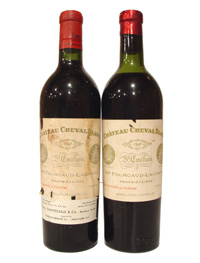
• When Losers Win: Lessons from the Greatest Wine Ever Made

    I count it my recent, good fortune to have discovered Slate Magazine. While their political pieces leave me ill, I generally find their food and travel section most agreeable (in fairness, their politics section is nearly always amusing, albeit repugnant). Last week’s article on the 1947 Cheval Blanc proved no exception to my guilty pleasure.

    For the $4 Merlot drinkers out there, the quick and dirty on the ’47 Cheval Blanc is that it is widely considered by wine connoisseurs to be the finest wine ever made. This point of itself will probably not surprise many. Even the most boorish among us can appreciate a fine wine. But what may be surprising, is the rest of the story (to quote Paul Harvey); and it is toward this literary end that Mike Steinberger’s piece in Slate Magazine is helpful.

    [Link]

    According to Steinberger, the birth of the ’47 Cheval Blanc hearkens back to the days of climate dependent vintages. Back in ye olden days of wine making, the Bordeaux region of France was renowned for producing excellent wines primarily due to its temperate climate. To wit, the Bordeaux region provided an ethereal mix of humidity and dryness, creating some of the most succulent grapes in the world; which were then used to create some of the most beloved wines in the world.

    What makes this point difficult to appreciate, as Steinberger notes, is that today nearly every vintage produced creates a drinkable wine. Be it the La Mancha region of Spain or, god forbid, Napa Valley here in the States, modern vintners nearly always get it right. Advancements in climate controlled cellars, modern farming technologies, and an abundant workforce all combine to make wine the $100 Billion industry it is today.

    Unfortunately, the cost-benefit trade off is that many wines lose their originality. Call it selling out to the man, if you will. In times past, wine production was eminently dependent upon the summer vintage. Factors contributing to the summer vintage included: whether the summer was too hot; whether precipitation was received in the correct proportion to heat; whether acts of God conspired to frustrate the above; and whether all of these factors at issue found an alignment of the stars in producing the perfect bottle.

    Enter the year 1947. Pakistan gained independence from Britain. Jackie Robinson became the first black to play baseball. UFOs were cited in Roswell, NM. President Truman implemented his eponymous doctrine. And a small vineyard in western France called Château Cheval Blanc was in the midst of what promised to be a rather terrible year.

    Building on his laconic imagery, Steinberger describes the challenge of that year as follows:

    July and August were blazing hot months, and the conditions turned downright tropical in September. By the time the harvest began, the grapes had more or less roasted on the vine, and the oppressive heat followed the fruit right into the cellar.

    Adding straw to the camel’s back, local ice distributors could scarce keep up with the demand for regional ice provisions. Many wineries were neglected for want of more pressing demands from butchers, fishermen, and presumably undertakers. Even so, by some, miracle means, the small vineyard at Cheval Blanc was able to forage just enough ice to save the vintage.

    Yet, this fact alone provided little consolation to the vintners. By nearly all accounts, the combination of scorching heat and steamy damp from that 1947 summer should have ruined the vineyard’s production. Rather, quite the opposite occurred:

    The ’47s signature flaws—the residual sugar and volatile acidity—were readily apparent, but it was just as Lurton had said: In this wine, the flaws inexplicably became virtues. The analogy that sprang to mind wasn’t port; it was Forrest Gump. This was the Forrest Gump of wines—clearly defective, completely charmed.

    At risk of seeming overly introspective, it occurs to me that much of life is quite analogous to the ’47 Cheval Blanc. It would be almost platitudinous to suggest that life is full of obstacles. Just ask any law student if you disagree with this given. But the interesting link between the story and life is how the improbable, seemingly dire circumstances of our existence combine to produce something truly magnificent.

    As Steinberger indicates above, it is the peculiarities and blemishes which make the world’s finest wine great. Consider that modern vintners have every technology and every comfort at their disposal in creating passable, drinkable wine year-in, year-out. Indeed, the entire industry prospers as a result of such technical prowess and dexterity.

    But what makes the greatest wine preeminent is its flawed idiosyncrasies.

    The ’47 Cheval Blanc is a wine which ought never to have been. Borrowing a bit from Steinberger, the wine is in fact very much like a lover- its faults become qualities. One learns to appreciate the flaws. What once was irksome becomes endearing. Borrowing from personal recollection, I believe this rifling to be mostly true. In fact, over time, love tends to become its own end. And eventually the loud imperfections of being slowly yield to the quiet acceptance of night.

    Parsing the matter theologically, it is not difficult to recall the words of Christ in Matthew 21:42:

    “The stone that the builders rejected has become the cornerstone.”

    [Link]


    Odd that the ’47 Cheval Blanc shares with the Savior the least common denominator of rejection. Yet, in their prime, both surely were rejected. Of course, both also had their own vindication in time. The Christ would go on to turn water into wine and save humanity. The ’47 Cheval Blanc would go on to turn wine into something different entirely.

    It may be a fair to question exactly what the purpose is of this ambling exploration of thought.

    I have no specific conclusions.

    The mark of a good lawyer is always to answer it depends, except when it doesn’t. But an important point for consideration in this assessment are the remarks made earlier about originality and vintage.

    Here lately, amid interviews and career workshops, I have come to realize that sometimes the trend of life becomes more important in our consciousness than the living of life.

    In fact, life, in many ways, resembles the plight of modern vintners. Streamlined. Efficeint. Predictable. Perhaps even stale (or at least starved for novelty). But good wines, like quirky people, remind us that breaking with convention is often a fine departure from the status quo.

    Going it alone, damning the man, or even fording the river- regardless of whether your oxen dies- can help one stay true to one’s self. Life, as a result, may still not yield the perfect bottle. Just look at the people around you. But what it does yield will still have done the trick.

    In turn, I think the following life lessons from the world’s greatest wine might be useful to consider:

    To the discouraged, I would posit that the summers of life need not leave you scorched.

    To the encouraged, consider your flaws- they may be your strengths.

    To the optimistic, I would posit that like modern vintners convention is not always best.

    To the dour, consider that even the worst of vintages can yield something great.

    And, most importantly, winners lose- like the 2007 New England Patriots. And on occasion, losers win- like the 1947 Cheval Blanc.

  • Song of the Week: Bigger Fish To Fry

    Having decided in the last week to resume the actual purchase of CDs, it seems appropriate to once again resurrect the Pax Plena song of the week.

    Here to kick off the latest weekly installment, the song below appears courtesy of Brad Paisley’s newest album, 5th Gear.

    I’ll not scoop the song but it is hilarious (though the user video created below is only mildly amusing) and even tangentially dabbles in theology.

    My regular readers will surely appreciate the heretic in me. The practical minded among us might even call it the Gospel in a nut shell.

    Please enjoy Brad Paisley’s Bigger Fish to Fry. Lyrics follow after the jump.

    Bigger Fish to Fry

    I said a bad word when I was a kid.
    Mamma said that I’d be sorry for the sin that I did.
    My daddy whooped me and the
    preacher said shame.
    And I tried like hell to change.

    But I cuss,
    And I smoke,
    I laugh at dirty jokes.
    The minor vices, man I know ’em well.
    I’ve closed down bars.
    I’ve lusted in my heart.
    My exes think I oughta burn in hell.
    But the devil, he won’t notice when I die.
    Yeah, don’t you figure he’s got bigger fish to fry?

    Politicians taking pork barrel bribes.
    Crooked CEOs are getting off with no time.
    Christmas Eve burglars stealing good children’s toys.
    (Can’t say Christmas).
    Holiday burglars stealing good children’s toys.

    I cuss,
    I smoke,
    I laugh at dirty jokes.
    The minor vices, man I know ’em well.
    I’ve closed down bars (yeah, many a one).
    I’ve lusted in my heart.
    My ex thinks that I oughta burn in hell.
    But the devil, won’t even notice when I die. (bet he does)
    Yeah, don’t you figure he’s got bigger fish to fry?

    Serve em up!

    (instrumental)

    Yeah there’s gonna be bonfire burning
    An everlasting barbecue
    But with all the bad stuff going on,
    There ain’t gonna be room for me and you.

    (Chorus 2)
    ‘Cause we cuss,
    We smoke.
    We laugh at Tater’s jokes. (spoken)-> Tell one Jim.
    “You know you’re old when your wife says ‘honey let’s run upstairs and make love’ and your answer is ‘I cannot do both.’”
    The minor vices, man we know em well.
    We’ve closed down bars.
    We’ve lusted in our hearts.
    Our exes think we ougta burn in hell. (you got it wrong, it’s the other way round)
    But the devil, he won’t notice when we die.
    Hey, don’t you figure he’s got bigger fish to fry?
    Yeah don’t you figure he’s got bigger fish to fry?

    Pass the tartar sauce

    When we all get to heaven what a day of rejoicing it will be.

  • Song of the Week: White Christmas

    The sun is shinning the grass is green. The cacti and palm trees sway…

    Not exactly how the song goes. But the Tucson iteration of Beverly Hills & LA is pretty close and as frustrated ex-Northerners bemoan the lack of snow in warmer climes it becomes ever clear that Christmas is upon us.

    With thoughts of home and snow fresh on the mind, the Pax Plena song of the week will be no stranger to the holiday musicphiles among us. Yet, the history of Irving Berlin’s White Christmas may well be relegated to the dusty box of family ornaments and the ghosts of Christmas past. What follows is a brief primer on America’s most popular Christmas song.

    Interestingly, White Christmas actually has an Arizona connection which had previously escaped me. According to legend, Irving Berlin wrote the song poolside at the Arizona Biltmore Resort and Spa just up the road from here in Phoenix. As the song hit airwaves in 1942, America was well into a period of deep uncertainty. In November, of the same year the U.S. Navy suffered heavy losses in the Battle of Guadalcanal and gasoline rationing began as a result on the order’s of President Franklin D. Roosevelt back home. Suffice it to say, the backdrop for the inaugural performance of White Christmas in the film Holiday Inn was anything but auspicious.

    But there was something special about the song. Berlin’s initial assessment of his work turned out to be quite prescient- it was indeed the best song he had ever written. White Christmas would strike uniquely at the core of the American psyche, bringing with it all the charm and romance of the Christmas season to a Nation in more perilous a position than ever it had been since its founding. Released (perhaps not serendipitously) during the height of World War II, the song became a smashing hit with the American Armed Forces stationed overseas. The lyrics easily bring images of hearth and home to mind some sixty-five years later. It is difficult to apprehend their effect on American servicemen stationed in North Africa and Guadalcanal as the song made its way over the Armed Forces Radio Network. Suffice it to say, its success was nigh instantaneous.

    By all accounts, the most famous version of the song remains the original rendition done by Bing Crosby in 1942. Its release then was actually just prior to the Christmas season and the song would go on to spend some 11 weeks atop the charts. It would return to the top twice more becoming the sole song in American history to make #1 three different times. The Guinness Book of World Records honors its as the number one Christmas song of all time.

    Notably, while the 1942 version of the song features (arguably) the grandfather of the crooner generation, it does not feature the initial stanza originally written by Irving Berlin in the early 1940s. Both on the recording and in the movie in which it was initially introduced to American audiences, Bing Crosby sings only the chorus and leaves out the initial stanza. To provide its full effect, the complete lyrics appear in below. Legend has it, the initial stanza was set to poke fun at displaced northerns living in SoCal, once again proving that it is never a bad thing to make fun of Californians.

    Even so, whether home for you is Los Angelas, Boston or Walters, please enjoy the 1942 version of Bing Crosby’s White Christmas courtesy of Songza.com.

    http://songza.com/e/listen

    White Christmas

    The sun is shining
    The grass is green
    The orange and palm trees sway.
    I’ve never seen such a day
    In Beverly Hills LA.
    But it’s December the 24th
    And I am longing to be up North.

    I’m dreaming of a white Christmas
    Just like the ones I used to know.
    Where the treetops glisten,
    And children listen
    To hear sleigh bells in the snow.
    I’m dreaming of a white Christmas
    With every Christmas card I write.
    May your days be merry and bright.
    And may all your Christmases be white.

  • Song of the Week: The Biggest Lie

    A thousand apologies for those who have written to complain about the absence of songs of the week. Blame it on finals. As an act of obeisance, let me say that this week’s song of the week will not disappoint.

    I rarely buy songs on iTunes. Although with “one-click” shopping and Apple so willing to store my credit card information, one might wonder why not. Even so, when I heard the song which follows I was utterly haunted and compelled to make the purchase.

    By all accounts, today’s featured artist Elliott Smith was a troubled person. Born and raised across the U.S. but primarily hailing from Portland, Smith’s life was shrouded in addiction and depression. In turn, his melancholic lyrics aptly reflect the tortured mind of a troubled soul. What makes his style of music so captivating is the clear high-tenor of Smith’s voice coupled with an almost wispy style of delivery. If one listens late enough, Smith’s singing can be mistaken for errant thoughts passing through the shadows of mind.

    By way of introduction, some of you may recall Smith’s music as featured in the Robin Williams’ film Good Will Hunting. The Pax Plena song of the week is taken from Smith’s self-titled, 1995 album- dubbed by critic Rob O’Connor as “one of the most understated and incredible albums to emerge from the indie-rock scene in the 1990s.”

    Please enjoy, Elliott Smith’s The Biggest Lie.

    The Biggest Lie

    I’m waiting for the train
    The subway that only goes one way
    The stupid thing that will come to pull us apart
    And make everybody late
    You spent everything you had
    Wanted everything to stop that bad
    And now i’m a crushed credit card registered to smith
    Not the name that you call me with
    You turned white like a saint
    I’m tired of dancing on a pot of gold flake paint
    Oh we’re so very precious, you and i
    And everything that you do makes me want to die
    Oh i just told the biggest lie
    I just told the biggest lie
    The biggest lie

  • Song of the Week: Tennessee Waltz

    My thoughts seem to be oddly turned toward Nashville this week. This afternoon, I stumbled upon an old favorite introduced to me during my erstwhile days at Dartmouth. Norah Jones with her smooth vocals and dexterous piano playing couldn’t have performed the rendition of the song any better.

    Without further ado the Pax Plena song of the week is none other than Redd Stewart and Pee Wee King’s 1947 hit, the Tennessee Waltz as performed by Norah Jones. Lyrics follow. Enjoy!

    (Note: The Tennessee Waltz is in no way intended to be confused with the Tennessee Waltz sting operation which sent several top Volunteer State Democrats to prison)

    Tennessee Waltz
    As Performed by Norah Jones

    I was dancin’ with my baby to the Tennessee Waltz
    When an old friend I just happened to see
    I introduced her to my loved one
    And while they were dancin’
    My friend stole my sweetheart from me

    I remember the night and the Tennessee Waltz
    And I knew just how much I had lost
    I have lost my little darlin’
    The night they were playing
    The beautiful Tennessee Waltz

    I remember the night and the Tennessee Waltz
    And I knew just how much I had lost
    I have lost my little darlin’
    The night they were playing
    The beautiful beautiful Tennessee Waltz
    The Tennessee Waltz