• The View From the Top of the World

    Some eleven years ago, Vanity Fair contributor Bryan Burrough wrote a lengthy, if not macabre, article about the disappearance of a pair of mountaineers who were attempting to become the first individuals to summit Mt. Everest.

    The two were an odd pair. The leader of the 1924 expedition was renown British mountaineer George Mallory, who was making his third and final attempt to reach the top of the world. His partner was an accomplished, yet comparative neophyte climber named Andrew “Sandy” Irvine. The trek up Everest was Irvine’s first.

    As the duo braced for the final push, ascending the mountain’s infamous “second step,” fellow mountaineer Noel Odell spotted the two in the distance:

    From what Odell could see, they had barely 900 feet to go before they reached the summit. Then a veil of high white clouds dropped across the mountaintop, obscuring Odell’s view, and the two men disappeared.

    Forever.

    [Link]

    The fate of the two men, and their success was a complete mystery, left shrouded in Everest’s icy mist until May 1, 1999, when a gaggle of American climbers found the proverbial needle in the haystack on Everest’s icy slopes, and discovered the body of George Mallory. Whether Mallory and Irvine actually reached the summit remains unclear.

    Burrough’s tale is, of course, gripping. He describes Mallory and Irvine’s ascent through the “death zone” of Mt. Everest, and explains the remarkable odds faced by climbers who challenge the angry mountain.

    Since Everest was first conquered by Sir Edmund Hillary in 1953, roughly 219 people have perished in their attempt to follow suit. The death of Francys (Fran) Arsentiev is a particularly harrowing account. Arsentiev was an American climber who was discovered alive though ailing on the mountain by a group of climbers. After assessing Arsentiev’s condition, and the weather conditions on Everest, the group left her to die as they made their ascent.

    The accounts and documentaries on the difficulties of summiting Mt. Everest, leave me utterly entranced by the human need to accomplish. We homo sapiens seem to have something hard wired in us that cuts across cultures, and prompts us to test our limits. In the Arsentiev story, climbers saw the risks that awaited them, yet left her to pursue their climb anyway. A more callous interpretation of the story is that the climbers’ need to reach the summit trumped their concern for human life, sentencing Arsentiev to death – though the matter is admittedly much more complex. As for Mallory and Irvine, climbing in 1924, they were attempting the impossible. Everest had never been climbed. Their gear consisted of woolen jackets and hobnail boots. The odds of success had them doomed from the start. And yet, they climbed. Some theories even have Mallory actually summiting before his death – a full 29 years before Sir Edmund Hillary.

    Mallory reputedly said he wanted to climb Everest simply, “because it’s there.” Whether the quotation is true or not, it aptly sums up a great deal about the life we live. Why did mankind go to the Moon? What prompted our scientific advances in medicine? What made Steve Jobs and Steve Wozniak create the Apple I and Apple II computers? What makes an otherwise sane person pursue a doctorate (in any field)? What makes a group of disgruntled taxpayers think they can defeat the most powerful nation on Earth? Why do we set New Year’s resolutions, run marathons, smoke cigars, play video games, or create works of art, literature, and music?

    In the end, all of our creative and aspirational undertakings amount to some variation of Mallory’s “because it’s there.”

    I doubt that I will ever climb Mt. Everest, but knowing Mallory’s story leaves me with the inkling there’s something fundamentally human about the view from the top of the world. It’s in our DNA. It’s the feeling everyone gets when we conquer our respective mountains – literally, or figuratively; wherever, and whatever they may be.

  • Book Review: Jesus, My Father, The CIA, and Me

    Jesus My Father The CIA and ME

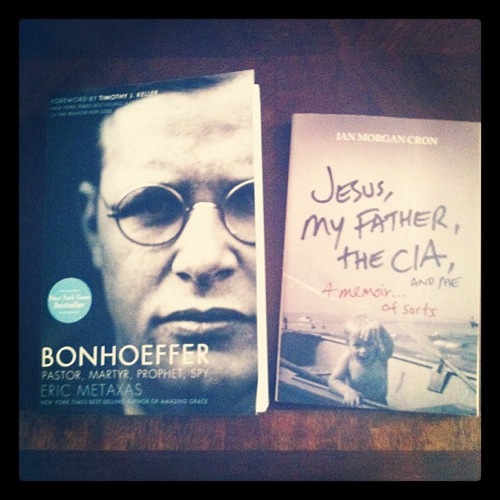
    On the shelves of our office library are a number of biographies. From Winston Churchill to Johnny Cash, we have no shortage of books about the lives of other, much more interesting, people. The number of memoirs, or autobiographies on our shelves is relatively paltry by comparison. This is not an accident. I tend not to buy memoirs because they are uniformly terrible. Given my reluctance to even read such a dust jacket, I was pleasantly surprised when I read Ian Morgan Cron‘s Jesus, My Father, The CIA And Me: A Memoir…of Sorts (Thomas Nelson, 978-0-8499-4610-3, $15.99, June 2011).

    From the outset, it’s important to recognize that writing an engaging memoir is difficult. Most attempts at autobiography try to paint life in its best light (think Sarah Palin’s Going Rogue). But it’s the rare, brave author who communicates the essence of a life as it was actually lived, as opposed to producing a censored version of how one would like life to have been. This sense of honesty is what really sets apart Cron’s book. Taking the back drop of an interesting, and complex childhood, Cron communicates in 252 pages the simple idea that life is messy.

    As I noted, giving life a sincere rifling isn’t an easy undertaking. Ours is a veritable age of depression. Whether it’s feeling inadequate for being stuck in the 99%, or latent concerns about the future of humanity, we homo sapiens tend to have more skeletons in our closet than Conrad Murray after a fresh supply of Propofol.

    But somehow, Cron’s memoir reassures readers that this is ok – that wading through the bullshit of life isn’t a journey taken alone, but something we all do to cope with the complexity or our own existence. Somewhere between page one and the end, readers come to understand that they are reading Cron’s piece, but the themes explored could well be their own.

    The most important theme of Cron’s memoir is how he copes with the chronic feeling of being unloved. I realize that at first this theme can sound a bit like a cliché. It’s fair to say that no one gets through life without developing some sort of “daddy” issue. But in Cron’s case, the daddy issue wasn’t a simple matter of Father threatening to pull the car over after roughhousing in the backseat finally got unbearable – say, hypothetically, on a trip to Taos, NM, circa 1989. Cron’s issues with his father involved the profoundly more complicated reality of having an abusive father who was not only an alcoholic, but also an agent for the CIA. As one would expect of a good Company Man, Cron describes his Father as being a bit “like Darth Vader, only less empathetic.”

    Detailing the life of a true Darksider, Cron painfully recounts numerous instances of abuse meted out by his father over drunken nights of scotch. While this is tragic in itself, the author suggests that the greater tribulation of his relationship with the elder Cron was the complete lack of interest he took in his son. The result is that the author was left to “begin life without a center of gravity,” foreshadowing the many ways in which the author would mirror the actions of his father.

    The second major theme of the memoir is something I’ve already alluded to. As a recovering law student, I’ve long taken it for granted that the majority of law students and attorneys are functioning alcoholics. And perhaps in Arizona more than most, we tend to revel in our reputation for debauchery. In fact, my alma mater the University of Arizona, James E. Rogers College of Law was recently dubbed “the top party law school” in the Nation. Work hard, play hard as the adage goes.

    While alcohol may be all fun and games here in Tucson, the hooch played a far more harrowing role in Cron’s memoir. In fact, some of the book’s most disturbing, and heartrending scenes come when the author describes the drunken physical abuse he endured at the hand of his Scotch-swigging father. What makes these moments even more poignant is that they serve as a dark segue into Cron’s descriptions of his own drunken nights and his painful mornings after. Even Darth Vader himself would mourn for the son who is controlled by the same ghosts that haunted his father.

    Finally, all of these stories, in some way reflect the final major theme of the book, the author’s journey as a person of faith. This shouldn’t be confused with dogmatic moralizing. The book is far from an exercise in Christian apologetics. Instead, Cron uses his life to illustrate how complicated it is to maintain faith in the Divine when so many aspects of life are unknown, unknowable, and often contrary, to the teachings of theologians and the various sects of Christendom. Rather than avoid doctrinal crises and moments of doubt, Cron honestly, and openly questions where exactly God was during his childhood, while admitting that he still “sees through a glass darkly,” lo these many years later. (1 Cor. 13.12).

    This is what makes the book so easy to appreciate. Unlike many Christian authors, Cron recognizes that grace isn’t cheap. Accordingly, he does not attempt to cheapen grace with empty platitudes of a “loving God,” or with talk of “damnation” for the sinner. Rather, Cron seems to recognize that in our own way we’re all damned — if not spiritually, then perhaps emotionally, as we struggle to confront the demons of our own past; or perhaps physically, as we yearn to strike a balance between work and life; or maybe even intellectually, as we attempt to maintain a sense of what is right, while also keeping our minds open to new ideas and change.

    Whatever the challenge, Cron never shies away from the truth. The events are never understated. The stories are simply told. This makes the entire account read less like an exposition of morality, and much more like a beautiful meditation on life. Cron reminds readers that life cannot honestly be separated into good and bad because both coexist on a continuum. There is good. There is evil. In the book, a father drunkenly beats his son. And later, a father overcomes his alcoholism, as he lovingly tries to shield his children from harm. And so the light rises from darkness.

    In the end, Ian Morgan Cron uses his life to demonstrate that mere existence can be tough. But it is only through this dose of realism that Cron can use his own life to demonstrate how one can also endure, and thrive.

  • Book Reviews for November and December

    Book Reviews Nov and Dec

    Late last week, I was pleased to receive the opportunity to review two more books in the near future. The titles released earlier this year, but newly minted paperbacks are just hitting the shelves.

    The first review will be of author Ian Morgan Cron’s newly released memoir titled Jesus, My Father, The CIA and Me: A Memoir…of Sorts. Cron’s book chronicles the early years of his life, and explores the complexity of growing up with an alcoholic father who was also a spook for the CIA.

    N.B. Cron is also an Episcopal priest, so the memoir traffics into some weighty topics including depression, alcoholism, and the concept of grace. For those who avoid such books, consider yourself warned. And for those curious, Cron’s memoir has received excellent reviews from Publishers Weekly, and perhaps unsurprisingly, the Archbishop of Canterbury, Dr. Rowan Williams.

    The second review comes from a similar genre, although it’s more historical in tenor than spiritual. Author Eric Metaxas is most widely known for having written the biography of William Wilberforce that inspired the hit movie Amazing Grace. (A personal favorite of yours truly). His latest biography titled Bonhoeffer: Pastor, Martyr, Prophet, Spy is poised to become a similarly big hit. Released in April 2010, the book cracked number four on the New York Times Bestseller List only this September, and received glowing endorsements from such sundry quarters as the Wall Street Journal, The New Republic, Christianity Today, and even former President George W. Bush.

    The lengthy biography, of course, details the paradoxical life of pastor Dietrich Bonhoeffer, a theologian cum spy who was intimately involved in a plot to assassinate Adolf Hitler during World War II. Bonhoeffer was summarily executed for his heroics by the Third Reich, leaving the pastor/spy’s legacy shrouded in myth, and reverence among modern Christians.

    Check out the Thomas Nelson Trailer here:

    As always I would be remiss if I did not thank the appropriate parties for providing me the opportunity to review their works. Special thanks to Ms. Meryl Zegarek and her team at Meryl Zegarek Public Relations, Inc.

    More to come…

  • Book Review: The Scrapbook of Frankie Pratt – a novel in pictures

    Book Review  Scrapbook of Frankie Pratt

    I think each of us has an inner packrat. Whatever the object – say, hypothetically, it’s an empty lighter from a Vegas casino where you celebrated your first wedding anniversary (I digress) – whatever the object, we tend to invest items with emotional significance because of the memories associated with the object. Just by looking at the item, we can go back in time. And we remember.

    It’s this feeling of reminiscence that Caroline Preston captures superbly in her latest novel, The Scrapbook of Frankie Pratt: a Novel in Pictures (ECCO/HarperCollins Publishers; ISBN 13: 9780061966903; $25.99; Hardcover; 240 pages; Release: October 25, 2011). The novel tells the story of its eponymous heroine Frankie Pratt, tracking her life from a modest, New Hampshire farmhouse to the City of Light and the Left Bank. Along the way, readers encounter Frankie’s various romantic interests, a host of literary luminaries, and Frankie’s witty impressions of the “whiz-bang” years of the 1920s.

    The story is interesting in its own right with plenty of twists. But what makes Ms. Preston’s novel really standout is the telling. Rather than following a conventional novel form, one void of pictures and so often void of talent, The Scrapbook of Frankie Pratt is an actual scrapbook built “item by item” from vintage 1920s memorabilia.

    The effort was obviously painstaking. Preston notes spending “countless hours” to amass the 600-item collection of 1920s ephemera required to tell Frankie’s story. This lends the tale an appreciable degree of authenticity, with every detail of Frankie’s life requiring a genuine period piece. The range of items is impressive, from a first-edition dust jacket of The Sun Also Rises, to the 1915 Corona typewriter used for the captions of the book. The end result is a 240-page novel comprised of full-color photographs of the scrapbook built by Caroline Preston. For bibliophiles, this means a new type of novel that readers can not only read, but experience in a concrete, visceral way.

    One criticism I expect the book will receive is that scrapbooking itself is an anachronism, a hobby lost in the digital age not unlike stamp collecting and the U.S. Postal Service itself. But even while the story is told in a very specific way, and set in a very famous moment in time, the larger theme driving Preston’s novel is one that every sentient person can relate to: memories.

    At its core, scrapbooking is about preserving memories by compiling a personal history derived from objects that people ascribe significance to. While Preston communicates this preservation in the form of a novel, the concept of memory has a lengthy scholarly history. One quick example can be found in the unlikely source of German philosopher Friedrich Nietzsche. In his 1874 essay, On the Uses and Disadvantages of History for Life, Nietzsche muses about the the role of history, and its implications for those sad souls doomed to live in the present. His conclusion of the matter is that “the unhistorical and the historical are necessary in equal measure for the health of an individual, of a people and of a culture.” The implication is that dwelling too much in the past, can inhibit human proclivities for progress, while living hedonistically in the present without regard to the lessons of history can lead to a vacuous existence full of narrow-mindedness and selfishness.

    Nietzsche’s observation is something we tend to internalize intuitively as a species. We give objects significance because they remind us of a special moment, or because they mark an important occasion. In this way, we tend to balance our ‘living in the now’ with memories and lessons from the past. What Caroline Preston does in The Scrapbook of Frankie Pratt is explore this tendency to preserve memories on a personal level through the lost art of scrapbooking.

    In truth, scrapbooking itself isn’t all the foreign a concept either. When I was a young child, my sister and I took a trip across the American west with our grandparents. From the backseat of a late-80s, Ford Crown Victoria, the four of us visited nearly every American landmark that mattered. We made stops at Petrified Forrest National Park, an honest-to-God forrest of petrified wood; a massive meteor crater that would easily swallow our hometown; the Mesa Verde cliff dwellings; and Grand Canyon National Park. On the way home, we stopped at Toys ‘R Us in Amarillo, TX, before hopping the highway for a stake at the Big Texan Steakhouse.

    From each stop, we gathered a small library of brochures, park guides, ticket stubs, and receipts.  And when we weren’t pestering our grandparents with questions, my sister and I managed to take enough cheesy photographs to make the other tourists blush. Tucked away in the Fodder family annals is a photo of my sister getting in trouble for trying to swipe a large stump of petrified wood, and a snapshot of me awkwardly lying down in four states at once.

    Five years later, Grandma would pass away. Though we had resolved to take another trip west, the stars didn’t align for us to make the trek again. But even after all of these years, that three-week trip was one of my best memories of growing up. Whenever I look at the old shoe box of memorabilia from the trip, I’m instantly taken back to the long hours spent in the backseat of my grandparents Crown Vic, staring at the rolling desert as we made our way west.

    My items rest in a dusty shoe box, but the transition from storage to scrapbook is fairly easy to envision after having read The Scrapbook of Frankie Pratt. And quite literally every person could do something similar.

    In this way, far from being an anachronism, The Scrapbook of Frankie Pratt captures something we can all relate to. We all have our own coming of age memories. We can all recall having taken a trip to some place special. And we can all think of objects that we have imbued with significance, either because they remind us of our youth, or because they remind us of a unique event.

    Memory is simply the collective human experience. Caroline Preston understands this, and manages to bring memory to life in The Scrapbook of Frankie Pratt.

  • A Dispatch from Taos

    It’s a drop past 11AM here in Taos Pueblo. The temperature has languidly paced it’s way into the 50s. A cool breeze makes its way beneath the carport here at my Grandmother’s house.

    It’s mid-October, but wood stoves burn in the distance, and the smells of piñon waft through the air as it has done for centuries in this ancient, mysterious place.

    There’s a shed across the dirt driveway. It is filled to the top of its 9-ft tall ceiling with enough wood to last two winters. I suppose the excess is important during the cold winter to come. But I’ve never seen the wood shed at less than capacity during any season.

    Maybe that’s the point. The cares and concerns here are about history and routine. Irrigating. Agriculture. Fishing. Hunting. Home repair. Tradition. Custom.

    In most respects, Taos is a full-throttled embrace of the historical. This disposition allows for language and tradition to coexist alongside the western/anglicized City of Taos less than a mile away.

    Naturally, this makes a balance with the unhistorical nearly impossible, as Nietzsche would say. Living in the moment, living for self, and the now are supreme challenges for Taos Pueblo and its denizens. Western arts, culture, and technology (aside from the ubiquitous Chevy trucks) are scarce on the reservation.

    Yet, as the leaves rustle, marking the passage of time, it’s a comfort to know that places like Taos still exist. Off the grid. A shrine to history.

    A place where time stands still.