• On Tragedy: Coming to Terms with Terms

    Clark  062018

    My son was diagnosed with an autism spectrum disorder earlier this week.

    While the diagnosis was not a complete surprise, to say that the news was personally devastating would be an understatement. After five years of explaining away the symptoms, after five years of hoping and anticipating that Clark would simply “outgrow” some of his peculiar behaviors, an expert from the University of Indiana’s Riley Children’s Hospital summarily crushed those hopes with the click of a mouse, and the stroke of a pen. 

    Naturally, I was crushed. 

    I can’t speak to how other, better parents would have responded to such news. For my part, my mind went into a spiral with a massive, neon “NO CURE” sign flashing before my eyes while I tried to sleep. Mostly, though, I thought about the horror stories of autism that I had read: 

    • Incidents of trigger happy cops murdering autistic men of color for simply having a blank stare. (Seems like a double whammy since Clark is both American Indian and autistic).
    • And even the latest news out of Miami-Dade County that would see Clark enlist in a “voluntary registry” with the police as a child ‘suffering’ from mental illness. (No way in hell). 
    • Would he even live to be as old as his mother, and reach the ripe old age of 36?

    I didn’t sleep much on Monday night. 

    The following day, I spent much of it trying to process the news, and how to sort out my own response going forward. Worrying certainly wasn’t helping.

    Rather than worry, I tried to think about the language I would use when describing Clark’s diagnosis in my day-to-day interactions. It seemed wise to use the proper terms – both for my own edification, and given the fact that our society is fraught with offense. These days, people tend to get pissed off by nearly anything that rustles their jimmies. I certainly didn’t (and don’t) want to offend other parents of special needs kids unintentionally. Better to save a good offense for when you mean it.

    In coming to terms with the terms of Clark’s diagnosis, the word that wanted glibly to sneak into my vernacular was the word tragedy. The Cambridge University dictionary defines tragedy as follows:

    Tragedy Defined

    I think the first definition is plainly eliminated. Clark isn’t dying anymore than we are all dying. And if the photo above is any indication, he isn’t really suffering either. His mischievous laugh, and megawatt smile certainly speak to the contrary. The third definition is also eliminated – at least until Clark decides to become an english major during college. 

    So really, the only way to classify autism as a tragedy is if one buys the second definition, and the narrative that autism is a situation or result that is ‘bad.’ And I’m not really convinced of this either.

    It’s very difficult to talk about the results and outcome of a life and call them bad when Clark hasn’t really begun to live. Sure, as life milestones go he was born. He learned to walk. He has mastered potty-training (thank God). He’s even developing speech and language skills. But the rest of the broad canvass that is his life is wonderfully, beautifully blank. 

    Now, it could be that his diagnosis will enable him to make a positive impact on the lives of many. I suppose it could be the opposite. After all, no one wants to think of raising the next dictator, but somewhere in the world there’s a couple or a parent who is doing exactly that. Regardless, it seems misguided to use a term like ‘tragedy’ to define a life that has not yet truly begun. Clark is five years old. His concerns this summer are when he will go swimming, and whether he can have only two Go-Gurts or perhaps sneak a third during breakfast. It’s a bit dramatic to say that his condition is a tragedy.

    Having reached that conclusion I calmed down a bit. I did some more investigating. I was intrigued to see that there are scores of parents and autistic folks who agree that tragedy is NOT how they would describe their lives, or their kids. From one parent, I learned that I’ve basically been doing everything wrong since Clark was born. From another, I was inspired to see that maybe I’m actually doing alright, and that perhaps triumph is a better ‘t’ word to describe Clark.

    Given the disparate reactions, I was relieved to confirm a lingering suspicion: no one has cornered the market on how to respond to adversity – particularly when it relates to medical conditions affecting loved ones. And especially situations that no one can control. 

    In all, I can’t say that I have any more answers than I did almost a week ago Monday evening.

    But I can say that I love my son. And that as long as I draw breath, I will strive to given him every advantage that I can, and meet every need that he has. Despite the seriousness of the news, it’s a comfort to see that, in some ways, nothing has changed at all.


  • Why Dads Matter

    My Post

    It has been a long while since I’ve graced the pages of Pax Plena with a new post. Given a quiet Father’s Day Sunday here in the U.S., I couldn’t think of a better time to resurrect our ailing blog once again. Like Lazarus rising from the dead, this disease of blogging silence never quite seems to lead to death. Our blog has merely fallen asleep.


    What prompted me to write this afternoon was an opinion column by the Washington Post’s Megan McArdle that shared some personal reflections on why fathers matter.

    [Link]

    Truth be told, I don’t really know of any camps that are ardently claiming that fathers do not matter. Granted, an article in the Atlantic, circa 2010, made the case that “there’s nothing objectively essential” about the contribution of a father to the well-being of a child. The point seems a bit weak. The absence of evidence is not evidence of absence. Indeed, other sources cite a wide body of literature that assess the importance of fathers and their role in fostering the well-being of their kiddos.

    Then again, it is the Atlantic, so one would do well to consider the source… 

    By contrast, McArdle notes of her own family life that “my mother was usually the one who dressed wounds if you fell off the jungle gym; my father was the one who encouraged you to climb a little higher than felt strictly safe.”

    Sure, the point is anecdotal, but I think it’s about right. In our family, Mother was always the one who set the rules, bedtimes, and made sure that we went to church. My Father seldom went to church, and had zero inhibitions about letting me ride in the open bed of a pickup truck while we drove around dusty county roads picking up cans to take to the recycling center. Note: This wasn’t something we did for the sheer virtue of a good deed, or environmentalism. There were no such bourgeois luxuries in the Fodder family of the 1980s. We just needed the money.

    Such parenting today would immediately draw the ire of the nearly every child advocacy group in America, and quite possibly one’s local Department of Child Welfare. Suffice it to say, times were different in the 80s. And, to be fair, if Dad had insisted that I sit next to him inside the cab of the truck, I probably would have pitched a royal fit, and left him wishing that I had just rode in the back of the damn truck to begin with. We poor kids could be a precocious lot. 

    But there was something that was actually quite important that I learned from those dusty drives with dear old Dad. I gained a sense of independence, and self-sufficiency that I never would have gotten had either of my parents been the “helicopter parent” that’s en vogue today. From Dad, I learned to search within myself, and try to solve problems instead of complaining about them. I learned that you can’t always have what you want, but that you can obtain what you want if you’re willing to work for it. And I learned that there are literally millions of ways one can perish by eating a Twinkie.

    (Family Joke: Whenever someone passes away, and one is foolish enough to inquire as to their cause of death within earshot of my Father, Dad’s glib response is always that they “choked on a Twinkie.” We usually groan and laugh, but I suppose normal folks might think this is morbid. Tomāto/Tomăto.) 

    And really, that’s why Dad’s are important: they show love to kids in a fundamentally different way from that of a Mom. And the difference is accounted for in that each parent brings their own lived experiences to the child rearing table, and kids are better for it. After all, what kid doesn’t need more love in their life?

    So, to all of the Dads out there, take heart: you matter. And don’t let the Atlantic tell you otherwise.

  • Analog Tools in a Digital World

    I broke my fountain pen this weekend. The imperial blue ink that I used in my Lamy CP1 had run out, and when I tried to refill the ink, I inadvertently broke the internal fill mechanism inside the pen.
    I spent many hours researching a replacement pen, but I couldn’t find a perfect substitute. Instead, I was left to negotiate the next best alternative and hope for the best. 
    In the process of deliberating, I found myself forced to consider the utility of using pens at all in our increasingly digital age. In really every respect, pens are bygone specters of an age long past. Their usefulness is almost as passé as the bottles of ink that are sold to fill them. 
    And yet, there’s something intangibly satisfying about setting pen to paper – to seeing one’s ideas made manifest in written form; to seeing one’s thoughts scratched on paper as mankind has done for countless centuries since that first ancestor etched stories on the walls of caves.

    Writing is primal. 

    Despite the fact that I pride myself on my technological prowess, that ancient link between humans, pen, and paper won the day. And it was rather an easy decision to write again. I hope it’s a trend that continues. 
    Suppose it should be easier now with my new Lamy Studio fountain pen – in imperial blue, no less. 
  • On Letting Go

    Fullsizeoutput 39a9


    I drove home from work on Friday. It had been a productive day.


    I had had meetings with our project team, wrapping up a major initiative that our Institute puts on every year. The feedback was helpful. To a person, we were all very pleased with how the initiative turned out, particularly given the vexing circumstances and truncated timeline that had precipitated its beginning.


    In the words of the ignoble Charlie Sheen, we were “#winning.” And we were all enjoying the moment of a job well-done. Rightly so. We deserved it.


    Fast forward to the end of the day.


    As the desert sun set over Tucson, I drove home, windows down, blaring Sinatra’s Nothing but the Best from my Ford Escape. True I wasn’t nearly as badass as the suped-up Tahoe next to me, which blasted Migos’s Bad and Boujee. But being neither bad nor a member of the bourgeois, I simply didn’t care. It had been a great day, and I was of a mind to head directly over to the store, in true bourgeois fashion, and pick up a few treats for my dog – which I did. #FirstWorldProblems.


    As Sinatra sang of bull fights in sunny old Spain, a smile graced my lips for the first time in weeks. Damn straight, Frank. The month of January had been hell. Friday was payday. From here on out, Nothing but the Best.


    Understand, however, that my version of ’the best’ may be a bit different than most. Mine started off at the local Walmart off of Wetmore here in Tucson. It’s an unprepossessing place. Its denizens are of the sort that would be ripe for cameo appearances on the “People of Walmart” website. (Note: I would make contributions to the site, the locale is that ripe for humor. But for all I know, I may well end up on the site myself one day, so why tempt the fates?) 


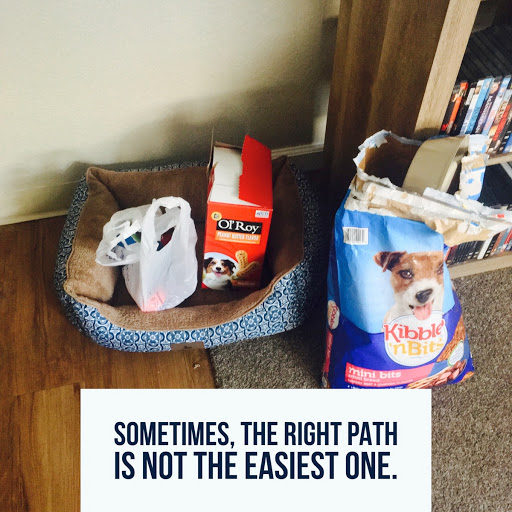
    Regardless, I joined my betters and wandered through cramped aisles, narrowly avoiding the carts and electric wheel chairs of the Walmart vanguard. Before long, I found all of the essentials for my little dog – a new crate, a new bed, and a box of treats as a reward for just how good he had been all week. 


    For the record, since my last post, not only did Nigel have zero accidents in the house (and zero incidents of destruction), but he also let me know every time that he needed to go out. Often, this amounted to jumping on the bed and kissing me awake at 6am (ALWAYS 6am – Every. Single. Day.). But I welcomed this outcome, as opposed to the times when he felt that he had no choice, but to soil his doggy bed rather than soiling the apartment. (Apologies if you have a weak stomach. No trigger warnings for you on this slice of the web.) 


    Ebullient, I drove home. So pleased to reward my little dog. It had been touch and go, but perhaps we had turned a corner. Leaving my wares in the car, I bounded up the steps, unlocked the door, and went in to check on my Nigel. 


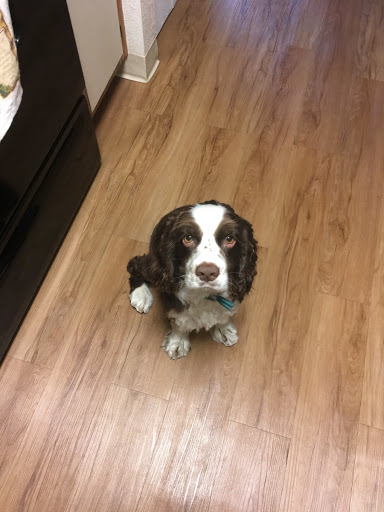
    He had an accident in his crate again. But his eyes were so overjoyed to see me. It looked as if he might burst from happiness. It was a magnificent reunion. While I struggled to unlock his crate, I saw a yellow stream of urine flow from between his legs as his body shook with excitement to see me.


    And my heart fell. 


    After taking him down, to do his business, I cleaned up the old crate, before promptly folding it up and throwing it in the trash. I would never leave him crated like that again. It was cruel. All while I did my work, he lay on the floor looking at me. 


    Fullsizeoutput 39a8


    It’s a strange thing to realize that one is wholly inadequate. That no matter the best of intentions, it will never be enough to meet the need/s of another. Such was my Friday night realization with Nigel – what he needed, I would never be in a position to give him:


    • Nigel needed a place to roam free. Because of his anxiety, I had to leave him crated during the day. 
    • Nigel needed consistent human interaction, lest his anxiety lead to an adverse outcome. I work a typical 9am – 5pm schedule and coming home for a mid-day hello is unrealistic.
    • Nigel needed an owner with energy and time to play. My idea of fun is firing up Call of Duty online.


    In my rationale, there was simply nothing that I could do to meet his needs, while also maintaining enough scratch to meet my own.


    Except, that I could find him a new home. And so I did.


    The internet is remarkably adept at facilitating pet adoptions. Within 14 hours, I had placed Nigel in a home with a large family, where everyone is home at some point during the day. They have two other Cocker Spaniels to keep Nigel company. And Nigel’s new home is much bigger than the two bedroom space I’m renting here in Tucson.


    It was the right call. But it certainly wasn’t easy. 


    Sitting here now, in the quiet of my apartment, I’m torn. Rationally, I understand that what I did was in the best interest of everyone involved. And yet, I can’t help but feel like I’ve failed Nigel. That I’ve followed the status quo and took the easy way out. On the other hand, I think about Nigel’s shaking after a day in the crate. His joy and relief (literally and figuratively) at being let out – and it somehow, seems cruel to keep him in such dire straits. 


    At any rate, the transition is done on my end. It’s only beginning for his new family – though they are well acquainted with the breed, and with the quirks of Cocker Spaniels in general. 


    Here’s wishing them my very best. And here’s hoping that my existential dilemma will have no bearing on their very practical efforts to take good care of my little dog. 

  • New Adventures in the Desert

    JPEG image 20953F655721 1

    I moved back to Tucson in early November of 2016. I hadn’t spent any time to speak of here since I left shortly after Clark’s birth in 2013. But a failed marriage (June 2016), new opportunities (August 2016), and the promise of sun (Jan – Dec. 2016) – all have a way of drawing a man back to a place.

    So, here I am beginning a new adventure in the desert. And if the early billing is any indication, I’m in for quite the ride.

    Truth is, while I love my job (more on that in a future post), a city can still be a dreadfully lonely place. Particularly when one is in their mid-30s, newly a bachelor, a bit out of shape, and settling into the routine of life anew.

    Given the predicament, this week, I did what any rationally-thinking, non-impusive, risk-averse person would do: I adopted a two-year old Cocker Spaniel.

    Originally, his name was Mickey. But this was far too plebeian for so august a dog.  So, I renamed him Nigel, after the sulphur-crested cockatoo in the cartoons Rio 1 and Rio 2. (See here).

    See also, exhibit A:

    IMG 2801

    Now, Nigel, is a wonderful dog in many respects. When I’m home during the day, on balance, he either lays in his bed or at my feet in a crumpled ball of fluff on the floor.

    IMG 2783

    Which was all fine until this afternoon. I came home from work per usual. The blinds were partly open just as I had left them. There was no barking or noise to speak of. And upon entering my abode, I see my pooch, bounding in my direction from the hallway, excited to see me, and even more ready to go potty downstairs.

    So far, so good.

    After taking him downstairs to do his business, I came back up, entered the apartment and pulled the screen door to. It was a lovely day. High 70s low 80s. And I wanted nothing more than to have some dinner and enjoy the evening breeze.

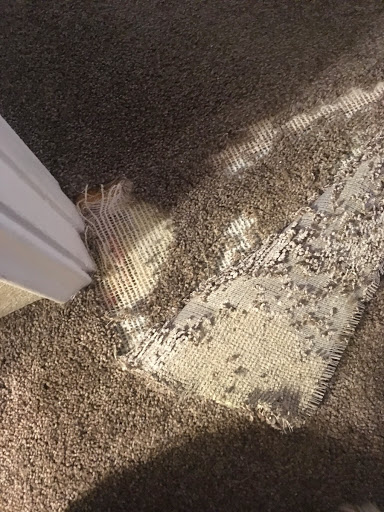
    As I’m mulling about, however, I glance in the corner near my bedroom door. The carpet looked oddly pixelated – as if the real life image I had tried to see was still downloading from the servers that span the breadth of time.

    It was only after I glanced again that I was able to process the magnitude of what had happened.

    Whilst away for the day, it seems that young Nigel tried to dig his way to freedom through the carpet of my hallway. Cue much wailing and gnashing of teeth.

    IMG 2823

    After conversations with friends, an expletive laden evening spent cleaning up the mess, and a couple of DIY videos on youtube for dog training, as it stands now, I really have two options for Nigel.

    I can:

    A) try to rehome him (viz., get rid of him); it’s an option that’s easy, elegant in its simplicity, and ruthless in its execution.

    Or…B) give him another chance; an option grounded in the hope that a sturdy crate and the promise of routine can mute his burrowing sensibilities. Not nearly so neat or final an option as A.

    It’s a tough call.

    Thinking back to last year, there were more than a couple of sleepless nights when I wish that I had had a second chance. Given the outcome, it’s especially ironic that the Christian set amongst us are so often the least forgiving. And as this applies to Nigel, do I really want to be like THEM?

    On the other hand, perhaps what Nigel did is beyond the pale? He did bore a hole in my carpet after all – a surely expensive mess that I will have to sort out with my apartment company.

    Nevertheless, at the end of the day, the rub seems to depend upon whether or not an ‘old’ dog can be taught new tricks. And, of course, the extent to which I am willing to entertain this fact. Funny how it is all sounding so very familiar…

    One can say many things about my life in Tucson. But it hasn’t been boring.