Tag: Faith

  • Some Thoughts About Our First Child

    Baby Fodder

    About a week ago, my wife and I found out that we are set to become parents sometime around October 22nd.

    The news was somewhat surprising, although not wholly unexpected. I considered sharing some of the details with you, but I think the entire matter can best be summed up in a bit of helpful advice to those actively participating in various forms of family planning: Doubling up on the pill after having missed a dose does NOT right the ledger.

    Just saying…

    Anyway, the funny thing is that for most of our marriage I have been the weaker part of our duo – the one opposed to all things baby, including baby carrots, baby tomatoes and baby as a term of affection for one’s significant other. In fact, my personal taste of hell was the time I booked a last minute flight to Oklahoma which left me wedged between two obese passengers and a screaming baby directly in front of me. I realize this sounds a bit like a cliché. If only reality had been so kind.

    Nevertheless, once we received the news and had it confirmed, my opposition to children strangely melted away. I found myself involuntarily wandering to Baby Ralph Lauren, Baby J. Crew, and scouring the web for a “big sister” t-shirt for our dog. I suppose even the mightiest wall can crumble. Any residual opposition vanished entirely when I saw the photo above and heard our baby’s heart beating at a healthy 179 beats per minute.

    Of course, my wife Gwyn has been ready for children for some time now. I don’t know that pregnant women ‘glow’ per se, but she certainly has a luminescence of late. And even if this weren’t the case, the grin she permanently wears all but broadcasts our news. In terms of health, and mood swings, I have to say that my cherished partner has done remarkably well. In fact, my lone complaint through the entire pregnancy, thus far, was the $8, CVS Pregnancy Test that she used to find out we were expecting. Obviously the home test worked just as well as any of the others, but something about it made me feel like a spendthrift considering the $149 Clearblue Easy Fertility Monitor that we could have been using all along. Apparently, if we had ordered on-line we could have gotten the thing for a drop over $6. At least we didn’t buy it on sale.

    I suppose the main reticence I have about welcoming my own spawn into the World stems from the abject fear that I will somehow find a way to royally screw up this parenting gig. Childhood is really one of the most formative periods in life. It’s a time that is both precious and precarious. Given the immense pressure to succeed (think Baby Mozart CDs, early childhood education, sports clubsprep schools, college expectations, etc.),  I still can’t help but walk into Fatherhood with some degree of trepidation.

    More immediately, my concern is that personalities are formed during childhood and the process and experience that go into forging a human being are extraordinarily subjective. Dreams are hatched in the minds of precocious young kids. And while some kids are headstrong and sarcastic (viz., yours truly), for others the least bit of negative feedback can crush a childhood dream in an instant (viz., most of Generation X). On the other hand, one moment of well-timed encouragement could well spark a life long fascination in a child’s mind that leads it to incredible success. The possibilities and nuances are beyond my comprehension.

    Aside from personal quandaries, I also can’t help but think about the type of world that our child will be entering. With sabers rattling in Iran, the pervasive threat of terrorism, and pink slime in school cafeterias, I think it’s perfectly reasonable to wonder about our child’s future and the challenges it will face in the coming years. Of course, this reminds me that every child that has ever been born has also faced uncertain times. Our child isn’t being born in the midst of a World War, for example. And our child will be born in the United States of America, which even in the midst of recession is still the most consequential and powerful country in the world. It will have advantages that many of its peers around the world lack and will always lack. It will have access to the internet, clean water, healthy foods, health care, education, shelter, transportation, information, two laughably overeducated parents and the world’s laziest guard dog. Our child will not have every advantage. But it will have every opportunity to succeed after a decent start. And as a result of its generally favorable provenance, it will also have a moral and ethical obligation to serve others. I can’t help but think it all quite a lot to expect of someone that is, right now, less than an inch tall.

    Assuming there is a point to be drawn from any of the above, I suppose it is the obvious – that life is chaotic and unpredictable. And that’s ok.

    The best we can do is embrace the unknown, pray for strength and wisdom in our successes and failures, and resolve to forge ahead, day by day. In other words, c’est la guerre.

  • The View From the Top of the World

    Some eleven years ago, Vanity Fair contributor Bryan Burrough wrote a lengthy, if not macabre, article about the disappearance of a pair of mountaineers who were attempting to become the first individuals to summit Mt. Everest.

    The two were an odd pair. The leader of the 1924 expedition was renown British mountaineer George Mallory, who was making his third and final attempt to reach the top of the world. His partner was an accomplished, yet comparative neophyte climber named Andrew “Sandy” Irvine. The trek up Everest was Irvine’s first.

    As the duo braced for the final push, ascending the mountain’s infamous “second step,” fellow mountaineer Noel Odell spotted the two in the distance:

    From what Odell could see, they had barely 900 feet to go before they reached the summit. Then a veil of high white clouds dropped across the mountaintop, obscuring Odell’s view, and the two men disappeared.

    Forever.

    [Link]

    The fate of the two men, and their success was a complete mystery, left shrouded in Everest’s icy mist until May 1, 1999, when a gaggle of American climbers found the proverbial needle in the haystack on Everest’s icy slopes, and discovered the body of George Mallory. Whether Mallory and Irvine actually reached the summit remains unclear.

    Burrough’s tale is, of course, gripping. He describes Mallory and Irvine’s ascent through the “death zone” of Mt. Everest, and explains the remarkable odds faced by climbers who challenge the angry mountain.

    Since Everest was first conquered by Sir Edmund Hillary in 1953, roughly 219 people have perished in their attempt to follow suit. The death of Francys (Fran) Arsentiev is a particularly harrowing account. Arsentiev was an American climber who was discovered alive though ailing on the mountain by a group of climbers. After assessing Arsentiev’s condition, and the weather conditions on Everest, the group left her to die as they made their ascent.

    The accounts and documentaries on the difficulties of summiting Mt. Everest, leave me utterly entranced by the human need to accomplish. We homo sapiens seem to have something hard wired in us that cuts across cultures, and prompts us to test our limits. In the Arsentiev story, climbers saw the risks that awaited them, yet left her to pursue their climb anyway. A more callous interpretation of the story is that the climbers’ need to reach the summit trumped their concern for human life, sentencing Arsentiev to death – though the matter is admittedly much more complex. As for Mallory and Irvine, climbing in 1924, they were attempting the impossible. Everest had never been climbed. Their gear consisted of woolen jackets and hobnail boots. The odds of success had them doomed from the start. And yet, they climbed. Some theories even have Mallory actually summiting before his death – a full 29 years before Sir Edmund Hillary.

    Mallory reputedly said he wanted to climb Everest simply, “because it’s there.” Whether the quotation is true or not, it aptly sums up a great deal about the life we live. Why did mankind go to the Moon? What prompted our scientific advances in medicine? What made Steve Jobs and Steve Wozniak create the Apple I and Apple II computers? What makes an otherwise sane person pursue a doctorate (in any field)? What makes a group of disgruntled taxpayers think they can defeat the most powerful nation on Earth? Why do we set New Year’s resolutions, run marathons, smoke cigars, play video games, or create works of art, literature, and music?

    In the end, all of our creative and aspirational undertakings amount to some variation of Mallory’s “because it’s there.”

    I doubt that I will ever climb Mt. Everest, but knowing Mallory’s story leaves me with the inkling there’s something fundamentally human about the view from the top of the world. It’s in our DNA. It’s the feeling everyone gets when we conquer our respective mountains – literally, or figuratively; wherever, and whatever they may be.

  • Book Review: Jesus, My Father, The CIA, and Me

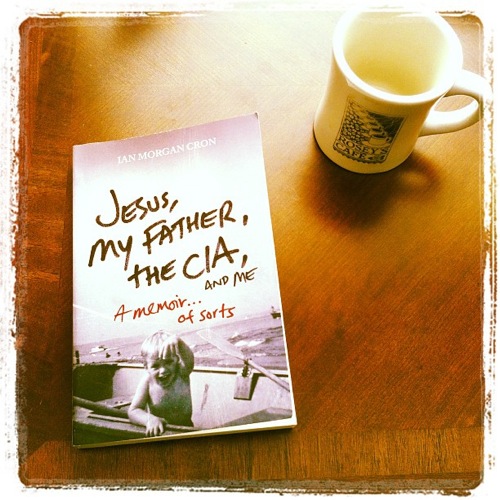
    Jesus My Father The CIA and ME

    On the shelves of our office library are a number of biographies. From Winston Churchill to Johnny Cash, we have no shortage of books about the lives of other, much more interesting, people. The number of memoirs, or autobiographies on our shelves is relatively paltry by comparison. This is not an accident. I tend not to buy memoirs because they are uniformly terrible. Given my reluctance to even read such a dust jacket, I was pleasantly surprised when I read Ian Morgan Cron‘s Jesus, My Father, The CIA And Me: A Memoir…of Sorts (Thomas Nelson, 978-0-8499-4610-3, $15.99, June 2011).

    From the outset, it’s important to recognize that writing an engaging memoir is difficult. Most attempts at autobiography try to paint life in its best light (think Sarah Palin’s Going Rogue). But it’s the rare, brave author who communicates the essence of a life as it was actually lived, as opposed to producing a censored version of how one would like life to have been. This sense of honesty is what really sets apart Cron’s book. Taking the back drop of an interesting, and complex childhood, Cron communicates in 252 pages the simple idea that life is messy.

    As I noted, giving life a sincere rifling isn’t an easy undertaking. Ours is a veritable age of depression. Whether it’s feeling inadequate for being stuck in the 99%, or latent concerns about the future of humanity, we homo sapiens tend to have more skeletons in our closet than Conrad Murray after a fresh supply of Propofol.

    But somehow, Cron’s memoir reassures readers that this is ok – that wading through the bullshit of life isn’t a journey taken alone, but something we all do to cope with the complexity or our own existence. Somewhere between page one and the end, readers come to understand that they are reading Cron’s piece, but the themes explored could well be their own.

    The most important theme of Cron’s memoir is how he copes with the chronic feeling of being unloved. I realize that at first this theme can sound a bit like a cliché. It’s fair to say that no one gets through life without developing some sort of “daddy” issue. But in Cron’s case, the daddy issue wasn’t a simple matter of Father threatening to pull the car over after roughhousing in the backseat finally got unbearable – say, hypothetically, on a trip to Taos, NM, circa 1989. Cron’s issues with his father involved the profoundly more complicated reality of having an abusive father who was not only an alcoholic, but also an agent for the CIA. As one would expect of a good Company Man, Cron describes his Father as being a bit “like Darth Vader, only less empathetic.”

    Detailing the life of a true Darksider, Cron painfully recounts numerous instances of abuse meted out by his father over drunken nights of scotch. While this is tragic in itself, the author suggests that the greater tribulation of his relationship with the elder Cron was the complete lack of interest he took in his son. The result is that the author was left to “begin life without a center of gravity,” foreshadowing the many ways in which the author would mirror the actions of his father.

    The second major theme of the memoir is something I’ve already alluded to. As a recovering law student, I’ve long taken it for granted that the majority of law students and attorneys are functioning alcoholics. And perhaps in Arizona more than most, we tend to revel in our reputation for debauchery. In fact, my alma mater the University of Arizona, James E. Rogers College of Law was recently dubbed “the top party law school” in the Nation. Work hard, play hard as the adage goes.

    While alcohol may be all fun and games here in Tucson, the hooch played a far more harrowing role in Cron’s memoir. In fact, some of the book’s most disturbing, and heartrending scenes come when the author describes the drunken physical abuse he endured at the hand of his Scotch-swigging father. What makes these moments even more poignant is that they serve as a dark segue into Cron’s descriptions of his own drunken nights and his painful mornings after. Even Darth Vader himself would mourn for the son who is controlled by the same ghosts that haunted his father.

    Finally, all of these stories, in some way reflect the final major theme of the book, the author’s journey as a person of faith. This shouldn’t be confused with dogmatic moralizing. The book is far from an exercise in Christian apologetics. Instead, Cron uses his life to illustrate how complicated it is to maintain faith in the Divine when so many aspects of life are unknown, unknowable, and often contrary, to the teachings of theologians and the various sects of Christendom. Rather than avoid doctrinal crises and moments of doubt, Cron honestly, and openly questions where exactly God was during his childhood, while admitting that he still “sees through a glass darkly,” lo these many years later. (1 Cor. 13.12).

    This is what makes the book so easy to appreciate. Unlike many Christian authors, Cron recognizes that grace isn’t cheap. Accordingly, he does not attempt to cheapen grace with empty platitudes of a “loving God,” or with talk of “damnation” for the sinner. Rather, Cron seems to recognize that in our own way we’re all damned — if not spiritually, then perhaps emotionally, as we struggle to confront the demons of our own past; or perhaps physically, as we yearn to strike a balance between work and life; or maybe even intellectually, as we attempt to maintain a sense of what is right, while also keeping our minds open to new ideas and change.

    Whatever the challenge, Cron never shies away from the truth. The events are never understated. The stories are simply told. This makes the entire account read less like an exposition of morality, and much more like a beautiful meditation on life. Cron reminds readers that life cannot honestly be separated into good and bad because both coexist on a continuum. There is good. There is evil. In the book, a father drunkenly beats his son. And later, a father overcomes his alcoholism, as he lovingly tries to shield his children from harm. And so the light rises from darkness.

    In the end, Ian Morgan Cron uses his life to demonstrate that mere existence can be tough. But it is only through this dose of realism that Cron can use his own life to demonstrate how one can also endure, and thrive.

  • My Trip to Costco

    Alexas Loves Costco.

    I took my first trip to Costco earlier this afternoon to purchase a membership. On the advice of a couple of friends, my wife was persuaded that the amount of groceries we purchase would easily make up for the price of joining over time. I’m not sure that it ever will, but that probably won’t keep us from trying to milk every bit of savings that we can out of our membership. In addition to an obscenely large bottle of Scotch, we also bought a doggy bed for Alexas that is certifiably many times larger than she is, selling for roughly half the cost on Amazon.

    Walking around the massive warehouse, I had several mixed reactions.

    My initial thought was “this is exactly why Al Qaeda hates us,” and while the conclusion is dramatic, it’s also quite true. If Costco isn’t the poster child for American opulence, then I’m really not sure what is. By every objective measure, that store is huge. Huge. It’s shelves, which span the entire height and length of the building, are stocked full of every conceivable product one could ever want or need. (Although, there was a notable absence of products from Apple). From discounted computer software to relatively inexpensive and presumably, relatively fresh salmon, the store was a treasure trove of American consumerism. Given economic disparities between countries like America and, say, countries like Afghanistan, it’s easy to see how the seeds of envy, jealousy, and hate could grow. Any ‘reasonable militant’ could simply look at places like Costco (or Sam’s Club, BJ’s, Walmart, Target, etc.), realize that such stores will never exist in her home country, and blame every economic woe on the ‘greedy Americans’ hogging all the goods.

    On the other hand, I realize that I’ve used a loaded term, consumerism. In fact, somewhat frightening, and almost certainly annoying protests were held this weekend warning of the coming ‘class war,’ demanding to know ‘which side are you on.’ I fancy myself as more of a Switzerland whenever the class wars are waged, but as an unabashed proponent of the free-market, the libertarian in me responds to the sentimentalist above by noting, “That’s just how markets work. Someone had the idea to form a company based on the concept of selling bulk products to consumers rather than selling to retailers only, and I’ll be damned if the idea wasn’t a smashing success. I will drink my ridiculously inexpensive alcohol tonight, and, accordingly, sleep like a baby – albeit a very drunk one.” The simple point being that if local supermarkets can’t compete, then shouldn’t they go out of business? Why should the market reward inefficiencies?

    But again the sentimentalist in me considers that the ground isn’t exactly level at the foot of the economic cross. Companies like Costco can leverage billions of dollars in annual revenue to sell products at deeply discounted prices thanks to their incredibly low product mark-ups. Mom and Pop supermarkets could never compete because they lack billions of dollars to leverage and offer competitive pricing.

    And on, and on the conversation goes. I don’t claim to have a solution. If I did have a solution, you could (and should) contact the folks at the Nobel Headquarters, and tell them this year’s Nobel Prizes for peace and economics have all but been picked up. I’d certainly be a more worthy recipient than our hapless President who somehow won the Nobel Peace Prize while orchestrating three wars around the world. Of course, he was only a warmonger twice-over at the time.

    Still, the interesting thing about shopping at Costco was the simple fact that no one seemed to be having the internal dialogue above in their heads – except for me. That’s when I realized that I am weird. So, rather than revel in my eccentricity, I happily walked up to the checkout to pay for the doggy bed and scotch, knowing that I would drink the scotch, and knowing that Alexas would still sleep in our bed rather than the doggy bed I had just purchased. In fact, after posing for the photo above, Alexas promptly got up, and lay down on our king-sized bed. And maybe that’s the lesson of consumerism.

    The point of consumerism isn’t really to be satisfied. That would make the world markets tank for sure. The point of consumerism is to feel you need something, pretend you enjoy it, and then lumber back to the bed you’re used to sleeping on.

  • Little Pricks

    Little Pricks

    The piece I wrote earlier in the week about Ben Stein and the economic meltdown has weighed on my mind lately. It isn’t a newsflash, but today’s headlines abundantly suggest that we live in an era of unprecedented economic uncertainty, and global unrest.

    Rioters in London burned their own homes in protest of UK budget cuts.

    Wall Street twists in the economic winds – soaring on the smallest glimmer of economic hope, crashing with the least bit of turbulence.

    Earlier in the week, naysayers warned of a Post-American planet, drearily musing whether we had already spent ourselves into oblivion.

    Meanwhile, others have taken a fancy to questioning the value of higher education, as if society would be helped by the masses remaining uneducated, helpfully observing that most Americans are wasting money on anything more than a high school diploma (special reference made to law students).

    In fact, people have become so fed up with bad news that nearly 200,000 people cancelled their cable TV subscriptions in the last quarter alone.

    Not even President Obama gets a break. The latest poll numbers, bless his heart, show Generic Republican besting President Obama 47% to 42%. And just a couple of days ago his vacation home on Martha’s Vineyard burned down (not really, but it did catch fire).

    Make of the above what you will, but it seems fair to say that times are tough.

    As the adage goes, desperate times call for desperate measures, so it seemed only appropriate to draw some words of wisdom from the Bible – just in case. Serendipitously, the writings of an old friend from high school (published on Facebook, no less), turned my weary eye to the fifth chapter of St. Paul’s letter to the Romans.

    Paul writes:

    Therefore, since we have been justified by faith, we have peace with God through our Lord Jesus Christ.

    Romans 5.1

    I won’t say the winds instantly calmed when I read the verse above. But something like that happened. I looked outside of the kitchen window, and saw our cactus sitting on the porch, warming in the sun, its tiny pricks of yellow gingerly reaching toward skies of blue. It occurred to me, that the world economy could crash this afternoon, and my cactus couldn’t care any less. So long as my wife provides it the occasional drink of water, it will thrive regardless of the calamities besetting the kingdoms of men.

    I can’t help but think the cactus has it right. The little prick. At risk of being over broad, the verse above strikes me as the simplest statement of Christianity ever written. At its core, the message is a compact one of assurance, written to all those twisting in the winds of the stock market, written to all those questioning whether their education is worth the price, and written to all those forced to watch Netflix Streaming because they cancelled their Cable TV package.

    The message is that faith in Christ yields peace with God. Nothing more. Nothing less.

    The other stirring aspect of the short verse is that it is without qualification. It does not assure peace only to stockbrokers. It does not assure peace if only we make the appropriate spending cuts accompanied by corresponding ‘revenue increases.’ The point is plain. Those justified by faith have peace with God. Period.

    Now, Stein’s article questions the premise of our calamitous world entirely. “Meltdown? What meltdown?” he would say. While it’s fair to question the origins of the situation, it’s also disingenuous to deny the phenomenon altogether. As my wife and I wait for student loans to come in, the reality of hard times is clear to us. We see similar concern among our circle of friends – mostly young professionals, and students, or some combination of the two.

    By contrast, Paul more or less takes the same approach to reality as my cactus Paul says, embrace reality. Sometimes life sucks, but come what may, those justified by faith have peace with God. It will be ok.

    And if that conclusion is good enough for my cactus, well, it’s good enough for me.


    PS: I realize the many jokes I could have made when I titled this post ‘little pricks.’ Most lawyers, Tiger Woods, and Ron Paul all come to mind. But gentle readers, I can only hope that my effort at more reflective commentary will compensate for lone cheap laugh I tried to get.

    UPDATE: Ben Stein adds some more thoughts in today’s (8/12/2011) essay on the ‘meltdown,’ and reaches somewhat similar conclusions to those I reached yesterday:

    6. The speculators do not have all power. There is only One who has all power and I live by His rules, not by the rules of fear and panic peddled by some cable TV systems.

    So, I can keep some perspective and go on with my life after all.

    And I can look out on this magnificent mountain lake and think how it must laugh at stock markets and the affairs of men.

    [Link]

    Stein’s lake laughs at the affairs of men, much like my little cactus laughed when I picked it up.