Tag: Native Americans

  • Endless Summers

    It’s been a minute. Half a year nearly. My plan coming into 2026 was to write more – and I have to an extent. Just not here. My journal is full. I’ve also unexpectedly written job applications and cover letters aplenty. But this space has surely been neglected.

    I think like many people who started blogging around the early aughts, the point was simply to share what was on the mind – whether it be about politics, faith or just what happened during the day. There was no rhyme or reason to any of it. I remember an embarrassing amount of two paragraph posts about nothing at all in the early days of Pax Plena. I also posted way more than I should have about politics (a quaint bygone era compared to the rough and tumble dissension we seem to have in the public conversation today). I even managed to continue posting through law school, my doctoral work and the early days of my academic career.

    Then things just gradually went off the rails. I started to self-censor. I was careful to the point of being paranoid about sharing thoughts or content related to my field. I felt the need to keep up a certain facade regarding my personal life. Eventually, all of the things that make a person interesting were out of bounds at least in terms of sharing and my own writing.

    Today, that notion of blogging is almost completely gone. There are TONS of platforms for sharing content. Pictures. Music. Videos. Memes. Things that are silly. Things that are sad. Sites for personal interests abound – fishing, gaming. watches, fountain pens, sports are a few personal favorites. There are also multiple sites for accessing content. It really doesn’t matter – if there is an interest in the content, whatever the stripe, it can be found in abundance.

    Which makes my whole exercise here at Pax Plena ripe for a revisit.

    Now that I lack institutional affiliation, I find myself wondering about the kind of content that I’d like to share. I wonder what folks would find interesting. I don’t feel the same shackles constraining me any longer. It’s almost like I can write about and say whatever I want again. It’s exciting but also strange. I suppose liberty can be that way.

    Most of my friends and colleagues don’t have this luxury. I know that some former colleagues do not write freely because professional obligations require them to self-censor. The first amendment may be alive and well as we approach America’s 250th Anniversary. But both the public and private sectors have a way of stifling speech that is far more nefarious than a lot of us think about. In the public sector, otherwise interesting writers are constrained to share or “publish” only the content that their bosses approve. If you are a federal worker, the authority of the President to fire simply doesn’t cut in your favor. In the private sector, thanks to the bastardization of at will employment, may workers find their speech rights limited by company policy, lest they find themselves axed for expressing an opinion that isn’t company friendly. It’s enough to make one wonder if the first amendment right to free speech is worth it. And for many it’s easier to self-censor rather than take the risk. Democracy truly does seem to die by a thousand cuts.

    So, I think it’s fair to say that I need to pause a bit and think more about what kind of content I’d like to share now that I have the luxury of freedom. I also need to think about what my stamina and pace of life will find manageable. I think I’m up for regular posts. A weekly essay would be interesting and doable – though it’s admittedly not very frequent. But I also don’t want to write just to write. So, I wonder what kind of value I can add to any reader’s life by my scribblings. The old adage is to write about what you know. These days, parenting and fatherhood, faith, doubt, job transitions, and relationships are all at the forefront of my mind. Maybe it’s just the general ennui of one’s mid-40s that keeps my focus so narrow. But it’s also good manners to stay in one’s lane so to speak. Lot’s to think about.

    For now, it’s Fourth of July Eve here in the USA. My nephew’s birthday will kickoff soon. He turns 12 this year. Hard to imagine really. It’s a funny thing with these kiddos: the time seems to pass so quickly.

    I can recall being 13 and the summers seemed endless. Back then I could while away an afternoon inside my grandparents’ house, parked in front of the AC reading the latest volume I’d slipped from the Library in town. Grandma would fix us lunch. There was the hope of fishing in the late afternoon still to come. The future then seemed so bright and exciting. There were no worries. No debts to pay. No utilities to cover or careers to maintain. No people to please. I had an unshakable, blind faith and confidence in the world and the people around me. I knew that they would take care of me and that all would be well.

    It never entered into my mind (not with any sort of fulsome reckoning), that one day, the people I love and trusted, the real grown ups in my life, would no longer be around.

    Seven years ago on July 4th, 2019, we all popped fireworks out at my Grandpa’s house. We did the same on July 6th at a relative’s place. I had no idea that less than a month later my Grandpa would be gone; that seven years later, Grandpa, the dogs in the picture, and even my relative’s partner – and a whole host of others – would all be gone. Such things do not really cross the mind of a grown man, not really. Let alone the mind of a child.

    This year, the Nation is 250 years old. I’m 43. My son is 13. And it feels like the entire world has changed.

    Summers, now, seem so quick. The future seems dark – like the best of days are all behind us. I find that I trust people less. And it’s a sad, thing to trust others less, particularly when I know how garbage of a person I am.

    On this 250th Anniversary of America, I feel most for the kiddos. It’s like the current generation of kids got all of the fake adults. I think that most of us Millennials really know don’t know how to adult. We all just woke up one day, and all of a sudden we found ourselves here with kids, jobs, relationships, regrets and none of the fun we were having back when we were 13. It’s not true but the whole thing doesn’t seem fair. Some days it doesn’t even seem real. Life is but a dream. It feels like maybe one day we will wake up and none of this will have happened. The world won’t be so chaotic. Mistakes won’t have been made. We won’t have elected a crazy orange dictator to leader our country. And I’ll be young, safe and happy once again.

    Maybe in the distance, my Grandpa will be lighting fireworks while the dogs trot behind him ready to sit back down when the nonsense is over.

  • Graduation Miracles

    This past Friday, the University of Wyoming’s American Indian Studies Program celebrated the graduation of seven American Indian students from college.

    The ceremony was fairly pro forma. Held at the Laramie Hilton Ballroom, flanked by family and friends, each student selected a faculty member to speak on their behalf. Each faculty member shared personal anecdotes about the student, along with a brief biography that the student had put together. It was a nice evening, but far from unique among the many graduation observances across the Nation.  
    I think what made the ceremony portion special, though, were the events that followed a faculty member’s remarks: every graduating student was presented with a Pendleton Blanket, long the gold-standard for gift exchange among American Indian communities. Once the ceremony was over, the invited drum group played a closing song, and an invited elder fanned each student with the incense of burning cedar (a process otherwise known as cedaring in Indian Country).

    It was a pan-Indian ceremony to be sure, but one that reflected the diversity of backgrounds and tribal affiliations of the Native students who call UW home.

    As the evening carried on, there were plenty of laughs and smiles, along with the inevitable tears of pride from families. But as we discussed the achievements of each graduate, it became easy to take their accomplishments for granted. After all, that’s what we do when we celebrate graduates. We celebrate their accomplishments – even if it’s merely finishing the arduous task of a university education itself. No small feat, but it’s expected. As a society, it’s what we do.

    Naturally, as I listened to the accolades, the mindset that “of course, students will amass a number of accomplishments” was never far from my estimation. And yet, now that a couple of days have passed, it’s clear to me that this is so very far from the truth.

    The article is a bit cold on the wires now, but according to Dr. Dean Chavers, Director of Catching the Dream (Ph.D, Stanford University), the accomplishments we witnessed on Friday night were actually quite rare:

    Only 17 percent of Indian students go on to college from high school. And since 50 percent of these high school students drop out before graduation, only 8.5 percent of Indian students enter college. This compares to 70 percent nationally. Thus Indian enrollment in college is only 12 percent of non-Indian enrollment. And 82 percent of these Indian college students drop out before they graduate from college; they never earn a degree. For every Indian college graduate per unit of population, there are 30 non-Indian graduates. And the gap has been getting larger over the past 40 years, not smaller. 

    Read more at http://indiancountrytodaymedianetwork.com/2012/06/16/myth-indian-scholarships-and-native-dropout-epidemic-118525

    Based on this assessment, a whopping 6.97% of American Indians will actually earn a college degree. Set aside the adversity of losing a family member in the midst of college, and set aside the rigors and stress of student competition at the highest levels of college debate (personal disadvantages that two of our students had to overcome), what we witnessed and celebrated on Friday night was the rare graduation of a group of American Indians.

    Far from falling victim of the statistics of Dr. Chavers, our UW graduates joined that narrow 6.97% of their American Indian peers and earned a college degree. Regardless of their GPAs and resumes, upon graduation, our seven students entered a meaningful elite – for who is better positioned to do more, to continue to compete, and to utilize the skills that they have learned to the direct benefit of their communities, than the Native students graduating from college?

    Indeed, perhaps, among no other ethnic group in America is a college degree so important as it is to Native Americans.

    And so, as our Native graduates move from hither to yon, I wish you all well. Thank you for the years you’ve shared with me. Thank you for the perseverance that you demonstrated, however fraught the circumstances may have been. And thank you for allowing me to witness as close to a miracle as we still have in this modern era – the celebration of your collegiate accomplishments.

    And most of all, thank you for the things you will accomplish. May your journal, henceforth, be blank.

  • The Art of Making Strategic Decisions

    In class this week, we walked through a few of the main arguments that set the theoretical framework for building effective tribal governments (See Rebuilding Native Nations).

    According to the authors’, one of the key elements for building effective tribal governments is for tribal leaders to engage in strategic decision making. The whole section reminded me a bit of the biblical adjuration, Where there is no vision, the people perish. I think that passage is actually talking about prophetic visions, but divorcing a quote from context has never stopped me before.  
    Regardless, the point is the same. In order to run an effective government, organization, institute, non-profit, etc., there has to be some vision toward which the entity aspires. For tribes, some of the questions include, What kind of society do we want to create? What’s our primary objective? What values guide our decision making? Where do we want to be in ten years? How do we get there from here? How do our values inform our policies? And, fundamentally, What do we want? 
    While the text applies these considerations, quite correctly, to tribes, the potential applications ofsuch analyses are actually much broader.  In fact, they even lie at the heart of the U.S. Presidential Election:
    • What kind of country do we want? 
    • Would we shut the borders of the United States to Muslims seeking entry? 
    • Would we seriously consider deporting 11+ million illegal immigrants? 
    • Why are we afraid to categorize people who are here illegally as illegals?
    • But, is deportation the best use of our rather finite National resources? 
    • Are we content with a criminal justice systems that disproportionately affects blacks? 
    • Are we content with a nation where top officials can flaunt their violation of our strictest national security laws? 
    • What kind of person would we like to see on the Supreme Court? 
    • How can we provide health care in such a way that we maximize the Liberty interests of citizens, while delivering the best possible service?? etc…

    The point is simply that the questions besetting tribes are no different than the kinds of questions that we face as a Nation. The only difference is that tribes must ask such questions not as free peoples exercising their right to self-government, but as wards under the guardianship of an external government that has assumed the authority to nullify their decisions with the stroke of a pen (See Congressional Plenary Power). 

    And so the question remains for tribal governments, When will the moment in time be right to challenge the legal presumption that Congress has absolute authority over American Indian tribal nations
    Granted, the time isn’t now. But when the time comes, what is the strategy for throwing off the yoke of Washington in order to truly allow tribes to engage in their own exeperiment in government by the consent of the governed?  And make no mistake, consent is key here. Any exercise of tribal self-determination must begin with the will and consent of Indian peoples. 
    Even so, what’s the plan? What would that form of sovereignty look like? 
    Lots of questions to explore and it’s only week one. Onward…
  • Blog Reboot, and Today’s Tribal Governments

    Today marks an interesting shift for Pax Plena. After years of personal blogging and sharing my thoughts on everything from political questions to parenting, I’ve decided to use this platform as a way to share more of my thoughts on my research and teaching interests. Naturally, I reserve the right to share whatever I like, but I hope to use the site as a way to test new ideas, and hopefully bring a bit of what I do in American Indian Studies to those interested. 


    So, consider this an effort to reboot the blog, and take things in a new direction. 

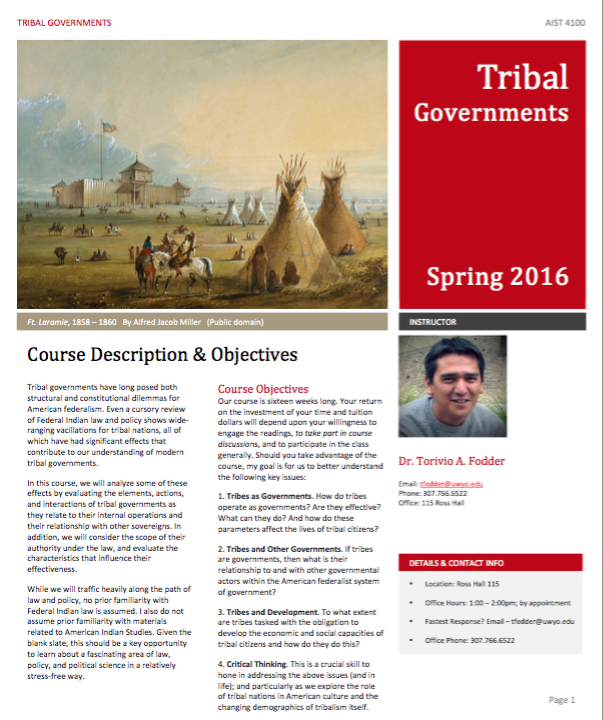
    Toward that end, I’m teaching a course on Tribal Governments this semester (AIST 4100). The enrollment is relatively small with only seven intrepid students eager to take on the complexities of America’s fourth form of government. 

    This is my third year to teach this course, and it has long puzzled me why a class with obvious relevance to a rural state like Wyoming would generate such little student interest. It could be that students are busy and have to prioritize their course load – an understandable outcome given the reality of the semester schedule and the respective demands of various majors across campus. But I suspect the lack of interest has more to do with the subject matter than it does with any scheduling conflicts.


    Part of the problem is that the notion of tribes as governments is something relatively foreign to many students. For starters, the governmental authority of tribal governments finds its genesis in a source of law that falls outside the bounds of the U.S. Constitution. The phrase we use in Indian law is that the governing authority of tribes is ‘extra-Constitutional,’ or one derived not from the efforts of our Founding Fathers, lo so many years ago. Such is the case because tribes pre-dated the U.S. Constitution by centuries, and in their drafting, the Founding Fathers simply did not incorporate tribes into the Constitutional framework.   

    So right away, from the very first day of the class, there is a disconnect to overcome. It’s certainly not an insurmountable barrier. But there’s a degree of difficulty in introducing a new form of government within the U.S. after years of civics courses have engrained in a student’s mind that federalism consists of federal, state, and local governments to the exclusion of all others. 

    And yet, it’s fascinating course to teach as an instructor. If there’s an area of governance where there is still ample room for innovation, development, and creative problem solving, then the work being done among American Indian tribal governments has to be among the most interesting around. My experience has been that students tend to appreciate this point toward the end of the semester – but at the beginning it’s still a distant concept.

    By the end of the semester we will have explored four theme areas: 
    • Tribes as Governments. Here, we explore the nuts and bolts of what tribes can do. Some things will be obvious – tribes can levy taxes, create their own codes and bodies of law, etc. Other things might be surprising to students, like the idea that tribes can issue license plates, or own businesses.
    • Tribes and Other Governments. This theme evaluates the contours of the relationships between tribal governments and the other governmental entities within the American federalist system. Primarily, it addresses questions of jurisdiction. For example, students might be interested to know that in most states, the state government has no jurisdiction over Indian reservations/lands. This may sound find, until students realize the problems this can create in terms of criminal law, given sparse federal law enforcement resources across much of the American west. 
    • Tribes and Development. For many students, this is the most interesting aspect of the course. Unlike mainstream, American governance, where a strong political current actually perceives government as an obstacle to economic progress (a view I’m not unsympathetic toward), when it comes to tribal governance, tribal nations uniformly play a large role in promoting economic progress and development. Often times, a tribal government will find itself in the role of a business owner. Such an action by government in the mainstream context would be rare, and mostly anathema to significant segments of the population. 
    • Critical Analysis. The final theme that I true to imbue in the minds of students is the notion of critical analysis – and the particular challenge of maintaining critical thought when it comes to our overview of tribal governments. While I consider myself an advocate of tribal sovereignty, I believe that it’s equally important for students to understand that tribes are fallible entities indeed. Not every tribe governs well. Not every tribe abides by the rule of law. And not every tribe ensures that its citizens are entitled to equal protection under the laws of the tribal nation. So, while the students will be learning about what tribes can and can’t do, what their relationships are like with over governmental entities, and the impressive innovations that can result from tribal/state/corporate/federal partnership, I also want them to maintain a healthy dose of skepticism throughout the semester, and to consider tough questions that, honestly, may not have an answer.
    Functionally, the course has always gone well. It certainly isn’t a required course by any means, so the students who sign up tend to have some interest in the class, which in turn makes my job a lot easier. Suppose we will know more on this score in a few weeks time, but I’m happy to have the students I met on Monday on board. 

    For now, I’ll leave it here, but don’t be surprised if additional comments and questions from the class make their way into this space. Truth is, I’ve missed blogging – so, it’s nice to have a way to incorporate my academic interests into our now 11 year old conversation here at Pax Plena. 

    More to come…
  • On Leaving

    The hardest part of the holidays is always the ride back to OKC Airport. I’ve made the trip a fair few times now, and while it becomes more familiar, I can’t say that it’s ever any easier.

    In my discipline, we often talk about the unique connection that American Indians have to their lands. And I think that’s right.

    But on days like today, as we prepare to depart and return to the regular business of busy and hectic lives, I wonder if we’re only discussing half of the issue in the relationship between native peoples and their lands.

    For my view, any attachment to place has to be coupled with the family/friends/loved ones who are there. Without relationship, a place is just a place. Land is just land.

    But when one adds in family, and friends, and loved ones, and multiplies this across the generations, an attachment to lands makes a lot more sense.

    In a way, we call this attachment, “home.” And leaving home is always a hard thing to do.