Tag: Native Americans
-
An Ode to the Rising Sun
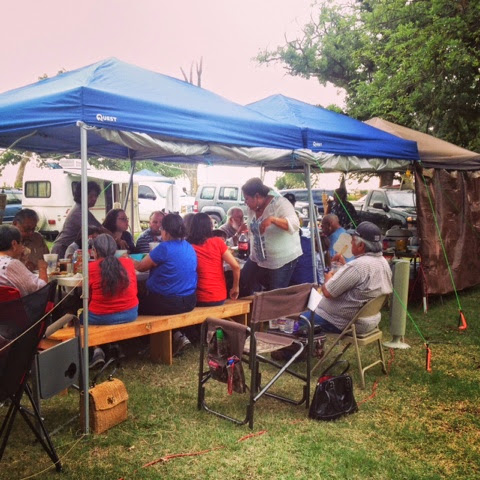
It’s a drop past 4pm here at Will Rogers Airport in Oklahoma City. As the canard goes, it’s not lost on me how ironic it is to name a state citadel of aviation after a man who died in a plane crash.AirborneA few hours ago, I said goodbye to Gwyn, Clark and Fan after a bittersweet farewell in Walters with Dad, Mom, Papa, Andrea, Jacob, Garrett, Seth, Chelsey, and our sister Randi Lynn and her son Drey. I made this latest trip home to see exactly this set of people. If there’s anything one can count on at all in matters of Comanche culture, it’s the opportunity to see family when one comes home.And so it is at the Comanche Homecoming Celebration, going strong some 63 years after its first incarnation welcoming home veterans following their service in the Korean War.Last night, sitting at our camp, with a canopy of stars under the dark Oklahoma sky, I was able to sporadically reconnect with friends and family alike – some of whom I had not seen since the last time I attended the Comanche Homecoming Celebration in 2005. Soaking up the moment, I was pleased to chat with long-time family friend, Tom Kavanaugh, a former Anthropologist and Curator of Collections at the University of Indiana’s Mather Museum. Tom is nothing if not friendly and blessed with a keen sense of storytelling, wrought from forty-odd years of accumulating insights into the history and culture of the Comanche People. His knowledge and enthusiasm is infectious.After listening a good while, I asked what someone with his experience would miss the most about the old days of the celebration and the old ways of doing things. True to form, Tom answered without hesitation, “I miss the people. They Keewainais (keh-why-nighs) who are no longer here but should be.”I didn’t have much of a reply. It’s sometimes hardest to respond when a person is so strikingly correct.Later that night over cigars with my brother Lucas Davis of Houston, TX (a distinctly Comanche brother who shares neither my tribal identity nor even my ethnicity), I thought about the event and its ability to pull together so many people, from so many places, and allow them to be a family.While I watched the crowds of people milling about the dusty creek bottom, I found that I couldn’t escape my conversation with Tom. A small place in my heart pinched at the thought of families and friends forever seared into my heart and mind – the ghosts of celebrations past who are forever sitting around the arena in Sultan Park.My son Clark received a Comanche name earlier in the day, one of the principal reasons hastening my return home. Such events are rare in life, watching one’s firstborn and his ascent into the ranks of warriors past. Fortunately, Clark was well-served in his naming by family friend/relative and my personal mentor Bernard Kahrahrah – a former Chairman of the Comanche Tribe. After much prayer, Bernard gave Clark the name Thaiori (Thy-oh-rē), which translates to the sun is rising.DenverI didn’t realize this at the time, but Clark’s name gives me a great deal of solace as I struggle to make sense of life, and all of the changes and opportunities that lie ahead. I think that even when one becomes melancholic for the ghosts of the arena, perhaps it’s wise to follow their example and pray for the generations that are to come, rising like the sun in the east, calling us to embrace the future of a new day.It’s always a good thing to come home – no matter how difficult it is to leave. -
Country and Culture
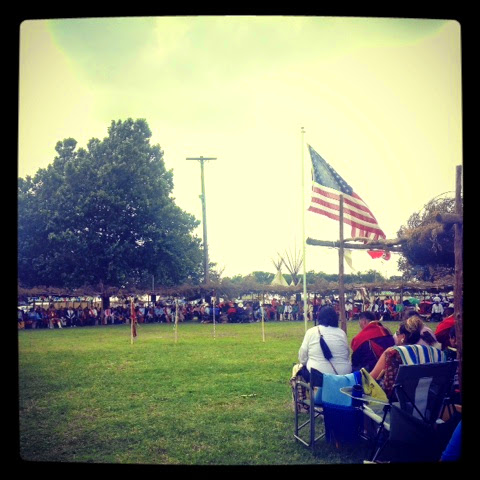
I’m writing today from steamy Carnegie Park, home of the Kiowa Gourd Clan’s annual celebration. While an American flag is prominently displayed in the middle of the arena and scores of veterans line the rows of chairs behind it, the event is decidedly not a celebration of America’s Independence from Great Britain.
Somewhere around the time that the Kiowa Indians came to call this part of Oklahoma home, the early days of July coincided with the ripening of the skunkberry, indicating that the time for holding the sun dance was near. As Kiowa warriors came to defend their territories in the infamous “Indian Wars” against the U.S. Cavalry in the late 1800s, trophies of battle were proudly displayed in the literal center of the annual ceremony. Given its origins, the event became more a celebration of tribal insurgency than a celebration of American Independence from European powers.
Yet, it is impossible to discount the appreciation for our country here marked by a plethora of red, white, and blue, along with the deep admiration expressed repeatedly for the young men from Kiowa Country who have fought with honor on distant shores. It’s also noteworthy that Native Americans have the highest record of military service per capita of any ethnic group in the United States. It is fair to say that American Indians are a rather patriotic lot all things considered.
But if there’s a conclusion to be drawn from the Kiowa Gourd Clan celebration and its implications for the nexus of culture and country, it is that America’s relationship with its tribal nations is rife with complexity. And though it may be surprising, it is exactly this complexity that makes the annual celebration here in Carnegie a quintessentially American affair.
A couple of years ago I wrote that America is like a large dysfunctional family. I think this is still mostly true. Consider the hullabaloo surrounding the Supreme Court’s recent Hobby Lobby opinion. Proponents of Obamacare and those who generally support the mass availability of contraception have bemoaned the “dangerous implications” of the Supreme Court’s “radical” decision. Meanwhile, faith-based organizations and those opposed to family planning have hailed the ruling as a profound “victory for religious freedom.”
Given our divide, it’s clear that both our internal relationship with other Americans, and America’s relationship with tribes, are complex things. And yet, like a marriage on the rocks, America somehow manages to hold it together year in and year out, providing relative stability for the world and bags of cash when good will isn’t good enough.
It’s true we can do more to cooperate and solve big problems. We can be more united and less inclined to bickering. But as a society we seem to hold our collective paradox rather well.
With our population so divided on so many issues, perhaps celebrating our cultural disconnects really is the best we can do.
-
Secular Thoughts and Sacred Conclusions

It’s a quiet morning here on the farm. My Wife, Son, and Grandfather have all made the trek down the road and up the steep hill to church. I’ve opted for a somewhat less holy morning of coffee and Emails. Not nearly as uplifting but we all have our spiritual needs I suppose.
Despite my morning of zen, a lot has happened in the past few weeks. Most recently, my baby sister graduated from high school, thereby ensuring my parents an empty nest if they ever permit her to leave. For now, her college plans include attending the local university and commuting from home at their insistence.
For my friends and colleagues not from Southwest Oklahoma, the graduation ceremony itself would have been somewhat of a surprise. Like the one hundred and five Walters High School Commencement ceremonies before it, my sister’s graduation was punctuated by very public references to God and Jesus with one precocious valedictorian going so far as to share the gospel from rostrum, complete with pastoral inflections and Biblical passages. Naturally, he was a preacher’s kid – the scion of the First Baptist Church minister no less. As if this weren’t enough, the baccalaureate service was also prominently advertised, directly opposite the graduation agenda on the official programs issued by the school. It was enough to make even this God-fearing agnostic’s head swirl. Suffice it to say, Jefferson’s wall of separation between church and state is in a bit of disrepair around here.
On the other hand, such a melding of faith and state wasn’t all bad. After a spirited debate with the powers that be, my sister managed to secure permission to wear an Eagle plume feather from her mortar board. Granted, the permission didn’t not come readily or perhaps even willingly, but we were all pleased nonetheless that the situation didn’t escalate. Last year, a Native American high school senior from Alabama was fined $1000 for her exercise of religious expression. The matter would have been especially ironic given the overt displays of religious expression throughout the ceremony. Perhaps the event will mark a new era of religious pluralism here in sleepy Walters, OK?
First Amendment questions aside, being home has been rather nice in other ways. We returned to America unexpectedly at the conclusion of my contract with the University of Waikato at the end of March. Fundraising had been a perennial problem for my employer, the University Waikato’s new Indigenous Governance Centre. But as you can see in the photo above, we returned to warm temps and mild summer evenings that provide ample time for walks down the narrow lane leading to our house. I enjoyed similar walks with my Son in New Zealand, but the area around our flat didn’t have the quiet, peaceful environs we enjoy here in the country. In a way, the biggest benefit to being home is how simple it really is.
While I poked a bit of fun earlier at the overt religiosity here in the veritable buckle of the Bible Belt, there is something to be said for the stability and simplicity of life gleaned from the faith that guides most people around here – a faith I once had. This is particularly true when one considers the relative chaos that seems to pervade everything else.
Consider that in just the past week alone, people much more tech savvy than myself have said that the security infrastructure of our computers and computer systems is “held together with the IT equivalent of baling wire.” Similarly smart people have questioned whether the crisis in the Ukraine could lead to another World War. And not long ago, closer to home, our State so thoroughly botched the execution of a man that he died of a heart-attack some twenty minutes after state officials halted the entire process.
Given such a comedy of errors, it’s nice to have a place that’s insulated from the madness – if only for a short while. But more on that to come.
-
What’s in a Name? The Redskins Mascot Controversy
I’ve resisted weighing in on the latest round of the Native American/American Indian mascots controversy. When such debates rear their heads, the conversation is rarely constructive. For example, of late, Washington Redskins owner Dan Snyder has been called both a racist and a bigot – and these were just letters from family.
(I kid. I kid.)
The current controversy actually has its genesis in a bill that was introduced in the House of Representatives this past March, long after the Redskins were unceremoniously bounced from the playoffs by the Seattle Seahawks. In legislation that was all but doomed to fail, Washington, DC Delegate Eleanor Holmes (D-DC) drafted legislation that would effectively void any trademarks containing the term “redskin/s.” Naturally, the bill would have a significant impact on the Redskins franchise, its revenues, branding, and merchandise.
Fast forward to this past May, when ten members of Congress sent a letter to Washington Redskins’ owner Dan Snyder demanding that the team change its name. Consider also that the least effective sentence in the english language always begins with the phrase “members of Congress sent a letter.” Even so, the brouhaha persisted, apparently undaunted by such realist frivolities. And, now, everyone from NFL Commissioner Roger Goodell to Rush Limbaugh has had their say. Most recently, ESPN’s Rick Reilly threw gasoline on the flames by sharing a few thoughts on the controversy in his weekly column. After arguing that the majority of the opposition to Indian mascots comes from “white America” Reilly concludes:
In fact, ESPN and many other media companies cover the Notre Dame Fighting Irish, the Cleveland Indians and the Atlanta Braves without a single searing search of their social conscience.
Doesn’t matter. The 81-year-old Washington Redskins name is falling, and everybody better get out of the way. For the majority of Native Americans who don’t care, we’ll care for them. For the Native Americans who haven’t asked for help, we’re glad to give it to them.
Trust us. We know what’s best. We’ll take this away for your own good, and put up barriers that protect you from ever being harmed again.
Kind of like a reservation.
[Link]
So, opposing a team’s mascot is analogous to putting Indians on reservations? Um, got it…
Cutting through the fog, it’s important to remember that such issues turn, as they always have, on the situation of the particular team and its relationship with American Indian tribes. The trouble when advocates claim a broad mandate regarding the sensitivity of a term or phrase is that their mandate is rarely as large as they perceive it to be. As of today, there are 566 Federally Recognized Tribes in the United States scattered across the whole of the contiguous 48 states. Also as of today, there has been precious little effort to determine what position each tribe takes regarding the Redskins mascot. Any party claiming a mandate or mantle of authority to facilitate change on behalf of American Indians en masse is simply misguided. While some tribes have signaled their opposition, the perspective of a few tribes is hardly representative of the whole of Indian Country.
On the other hand, the conversation being raised by opponents of the mascot is an important one for America to have. As a Nation, we tend to handle race relations about as well as we handle Middle Eastern crises and occupations, not very well. (Here’s looking at you Syria.) The fact is, the status of American Indians within the legal framework of the United States has long been a point of internal and Constitutional tension. As a society (and certainly our Government), we Americans don’t really know quite what to do with Indian tribes. Whereas the Civil Rights movement was about incorporating disempowered minorities into the American social fabric, what American Indians advocate for in pursuing policies of tribal self-determination and sovereignty is one of measured separatism. In other words, they seek to be left alone so that they can govern their peoples, lands and resources. Naturally, a very real disconnect in the conversation results because matters of racial stereotype are almost perpetually conflated with matters of tribal governance.
For the current debacle, I don’t see a tidy resolution to the situation. The Federal Courts have already concluded that the mascot name is not so offensive as to invalidate the Redskins trademark – and even if it is, the matter has lain dormant so long as to make the allegation moot. Short of pursuing abject censorship along the lines of Delegate Holmes, I don’t see a legal solution to the quagmire. Ironically, this would suggest that the groups opposed to the mascot are following exactly the proper course, seeking to influence public opinion and persuade the whole of society that the name is offensive and should be scrapped.
Personally, I think tribal advocates are playing small ball by focusing on the mascot issue. There are real enemies to tribalism in the United States and given the pecking order of threats, the name of a mediocre football team just isn’t worth the energy being expended. Even if I were a Washington Redskins fan, I can’t see the mascot issue being a bigger concern than the Redskins’ 0-3 start, and the inability of a much lauded second-year quarterback to deliver.
Of course, as a Dallas Cowboys fan, I don’t really give a damn. The team from Washington can be the Redskins or the Lobbyists and all will be right with the world if the Cowboys come away with a win.
-
Why I Love America
A prominent Native American law blog I follow posted a tongue-in-cheek message to Americans celebrating the Fourth of July. The headline declared:Happy Fourth from the Merciless Indian Savages
[Link]
For the confused, the headlined referenced a brief passage from the Declaration of Independence, listing the offenses of King George III. The excerpt appears in full below:
He has excited domestic insurrections amongst us, and has endeavoured to bring on the inhabitants of our frontiers, the merciless Indian Savages, whose known rule of warfare, is an undistinguished destruction of all ages, sexes and conditions.
It’s true that the United States has had a violent relationship with American Indians. From an abject policy of destruction and relocation hailing from the early years of the Jackson Administration, to a policy of systemic termination of tribal governments, I suppose if any group in America has a grievance against the government we celebrate today, it would be my people, the Native Americans.
The point is not to measure effronteries, but I can understand the purpose in the making the statement. The simple fact is that America is neither a perfect angel, nor an evil villain as the social extremes would suggest.
The best description we can give America is that we are a wonderful, complicated, dysfunctional family.
Think about our family tree. We have Bible-beating aunts from the midwest. We have uncles that drink too much from the south. We have mothers and fathers who don’t speak to each other anymore (but refuse to divorce for tax reasons) in the northeast. And we have lazy cousins who would rather be professional students than get a real job from the west.
But even the most dysfunctional of families has to come together every now and again.
So, we have an annual probate meeting to discuss the estate of our late Uncle Sam. Each family sends its delegates to the meeting down in Washington, D.C. where they take in the sights, and pretend to be very busy. Being a family meeting, however, you can imagine how little they actually get done. In fact, they spend most of their time yelling at each other, drinking, and having the odd sex scandal. The end result is the occasional bastard child, and the need for years of therapy.
But sometimes we really do come together, and get important, things, done. This doesn’t happen often, but it does happen on occasion. And when it does happen, we’re a stronger family for it. That is until the next time Uncle John gets drunk watching Nascar, and mocks Cousin James for his vegan lifestyle in San Francisco. Then we have a family World War III and Grandma and Grandpa have to step in and settle things down.
And that’s why I love America really. We behave just like a family, only on a bigger scale. And even while we may loathe our cousins for being self-righteous, at the end of the day, we would miss them if they weren’t around anymore.
America’s greatness isn’t the moral high-ground we sometimes claim. And our weakness isn’t that we drive trucks instead of hybrids. America’s greatness is that we manage, somehow, to get along. Mostly.