Tag: Philosophy

  • My Neighbors

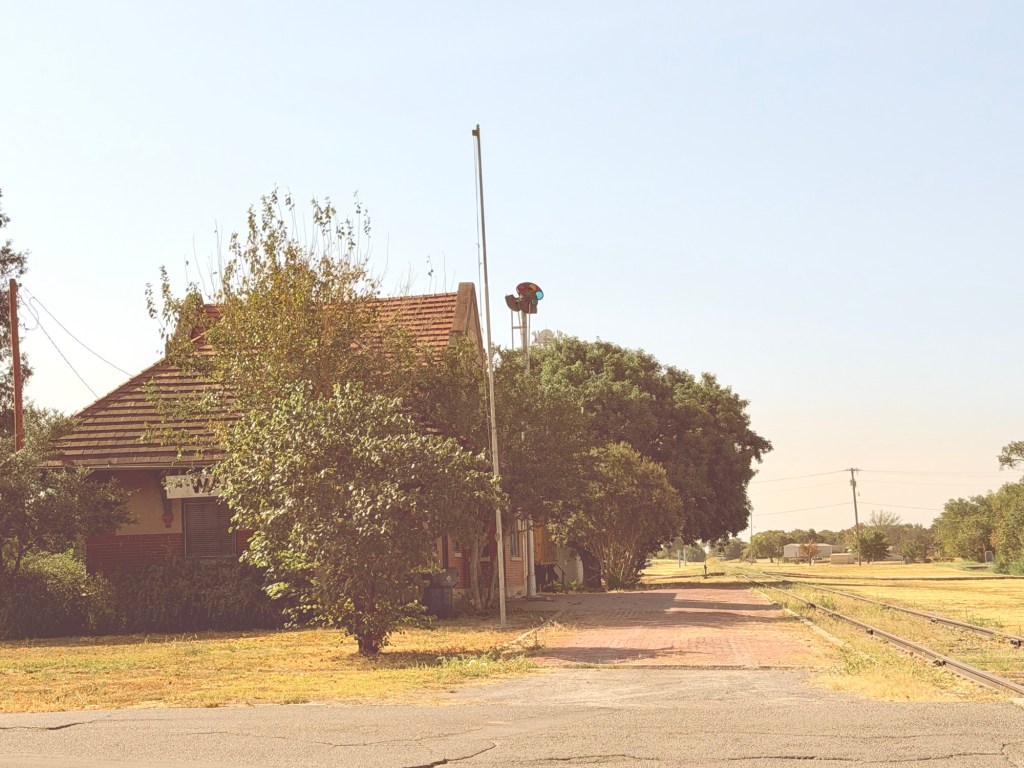
    Back in Walters, I live about a block from the old train depot. Built in 1920, the Rock Island Depot put Walters on the map in Cotton County and heavily influenced the town’s selection as the county seat. The line itself served primarily as a local passenger stop along the Rock Island and Pacific Railway line – although the tracks eventually linked up to points well beyond the confines of Cotton County, particularly once one reached Oklahoma City or Dallas.

    Today, the depot is on the National Register of Historic Places. It mostly hosts community art events and is home to a newly-minted playground for the kiddos in town.

    I guess one could say its heyday has long passed. But it’s still interesting to think about the people that boarded and disembarked all those trains back in the day. The passenger line ran until the 1950s before cost cuts closed the local lines, opening the tracks to mostly freight (viz., grain) until the depot’s ultimate closure in 1980. Sometimes when I walk by, I think about the age when train travel was a major form of transportation. Folks boarding and waving good-bye to loved ones on the red brick walkway outside. Perhaps soldiers going off to war or returning from battle. Thousands of lives lived and now long gone, even while the building remains – a testament to life in a different era.

    I sometimes wonder about the lives of those people. What their goals were. What they dreamed of accomplishing. The people they were dating. Who their friends were. What they did for work. What they did for fun. How did things turn out for them.

    That kind of wondering has a way of raising larger questions. Lately, I’ve been reading about different schools of psychology and the great debate between Freud’s etiology and Adler’s teleology, and the contrast keeps returning to me. As a former, law-trained academic, I’m out of my depth, but the difference is clear enough. The rub of Freudian etiology looks to the past as a way to explain current behavior. Meanwhile, Adlerian teleology looks to purpose and what a particular behavior is trying to achieve, and whether that purpose can be redirected toward more constructive ends. To a layman like yours truly, the differences seem like an exercise in semantics. But they’re actually quite distinct.

    In Freud’s world, people are the way they are based on their past. And the way to address the present is to work through what has happened in the past. In Adler’s world, a person’s past is irrelevant. What matters is the goal a person is trying to achieve through a behavior, and how to redirect the individual toward a more constructive goal. Freud asks, what happened. Adler asks, what’s the point.

    The link between etiology/teleology and the depot actually gets back to an ancient question that was also posed by a lawyer to Jesus: “Who is my neighbor?” While the depot itself is surely in the neighborhood, I can’t properly call it a neighbor – no matter how compelling the depot’s past may be to Freud. Adler, by contrast, would say the history of a building and its former patrons really isn’t that important. What’s more important are the interpersonal relationships I have with the people around me right now. In other words, my actual neighbors are all of the people who live in my vicinity. My neighbors are the people I worked with. My circle of friends. My family. My child. My person here in Colorado. Location doesn’t matter so much as the depth and breadth of the interpersonal relationships that make up my life.

    And I think that’s a good thing. Perhaps I am, by nature, much more Adlerian than Freudian.

    To me, dwelling on the past only accomplishes so much. The real question for each of us is, “what are we trying to accomplish in the limited time we have on this earth?” I think when we put life in stark contrast to the ticking clock that I’ve alluded to in other posts, it makes one acutely aware of the need to treat each moment as an irreplaceable gift.

    Maybe that’s the point. It’s fine to think about the people who have come and gone from the old depot. It’s okay to wonder about their lives and even about what life was like way back when. But that’s not the same thing as loving your neighbor. Loving your neighbor requires active participation. It’s contemporaneous. It requires an investment. And even as frightening as investment can be, even a failed investment of time, love, energy, and effort is better than having never left the past.

    So, I think Mr. Rogers said it best: “Won’t you be my neighbor?”
  • A Visit from a Friend

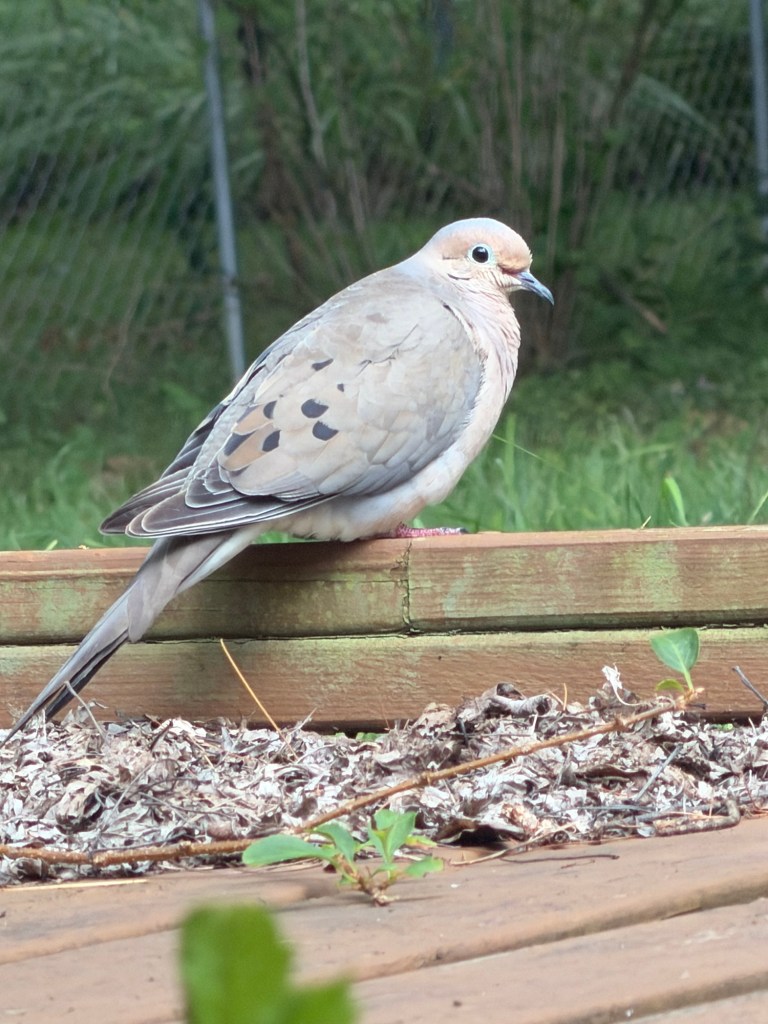
    A Mourning Dove. I call him Dave.

    I’m in Indiana this week. My time of being a nomad is well underway. It’s cloudy and muggy out. The heat grasps at the moisture in the air. It’s oppressive. Not quite as dreadful as DC in the summer. But pretty close. Even the squirrels and chipmunks have stilled their play to allow the afternoon heat to drag on.

    Soon, I imagine, they will resume their scurrying and gathering, or whatever it is that my friends do during the heat of the summer. My ex-wife’s backyard is filled with animals. I usually spend my days at the dining room table with an unobstructed view of the backyard. When animals make their way onto the deck (which happens fairly often) I call them my friends.

    So, with my friends scampering about, I suppose that the only idle one around here is me. My son has resumed school. His family here has resumed their work routines. My girlfriend in CO remains busy doing attorney things while maintaining her home for her kids. My family in OK are all, well, doing okay! Work, School, and Church seem to run the days there.

    The Sentinel.

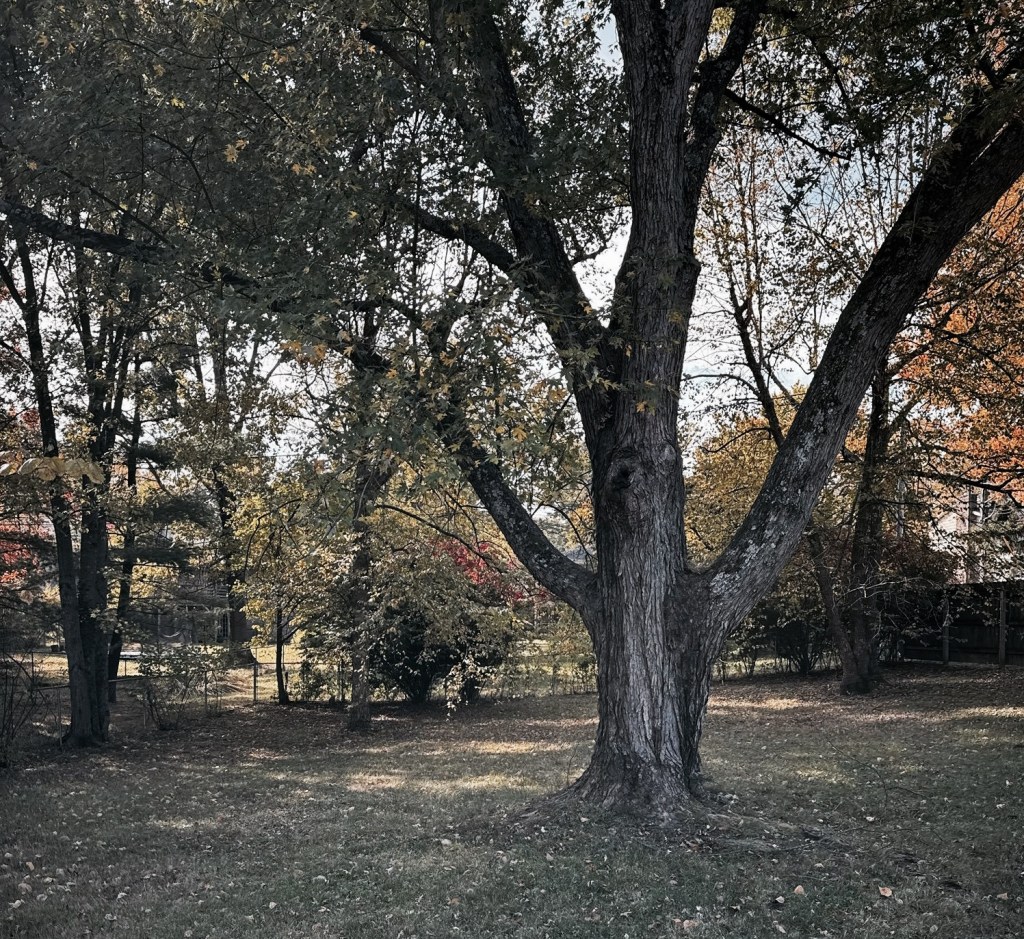
    As I thought about the constant motion, it occurred to me that I felt a bit like the tree in the backyard. I call him The Sentinel. A fine specimen of a sugar maple, he stands athwart the chaos of days and looks calmly on. His stately branches reach out and provide shade and shelter as the world passes by. It could be said that he stands idle. But, at risk of being overly animistic, I don’t think he does. I think there’s a wisdom to watching and learning before acting. At least that’s what I think he does, and what I hope I’m doing.

    At any rate, what made today especially interesting was that a mourning dove joined me on the deck this afternoon. He was a handsome fella. He seemed rather content to join me and sit on the deck while we awaited the afternoon thunderstorm. As the humidity rose, I began to wonder where he would go should it truly start to rain.

    It prompted me to learn a bit more about mourning doves. I read that female mourning doves sit on their nests from late afternoon throughout the night. So, I figured that this mourning dove, who was decidedly nowhere near a nest, was a male. For all I know, he had just finished the morning shift of nest sitting and was cooling his heels until the storm arrived or passed. I’d say, he was here at least 20 minutes.

    In considering his stay, my mind began to wander, and I grew concerned for him. I hoped that he wasn’t injured.

    But isn’t that rich! He was doing what I was doing. Together, between me, the bird, and the tree, we were all idling and whiling away the afternoon. There was nothing wrong with me. The tree seemed fine. Yet, I immediately wondered whether there was something wrong with the bird.

    It wasn’t a flash of insight, but it struck me that maybe a guy just needs a damn break from time to time. And while it’s not popular in our culture and economy to take breaks (Gasp! Resume gaps!), maybe taking a break is okay.

    Because, come 6AM tomorrow, I reckon we’ll both be up, taking care of the kids, and doing all the things, all over again.

    I learned a lot today. I’m glad my friend stopped by.

  • A Visit to the Museum

    Te Papa Tongarewa Museum here in Wellington, New Zealand is every bit the epitome of a modern state museum. But what makes this one especially interesting is that its cavernous halls are home to some of the most exquisite collections of Māori artifacts in the world. Our group from the University of Wyoming traipsed through this morning for a quick 90 minute tour of the museum’s Māori highlights. 

    Our tour guide was a surly woman. Short. Somewhat portly. The tenor of her voice bespoke an annoyance with the very premise of answering questions. Naturally, this effect was amplified on those rare occasions when one of us dared to ask one.

    This seems to be a thing with tour guides on this trip. In a separate incident while touring Parliament yesterday, a different guide actually yelled at a poor girl from our class when she paused to use the restroom before the tour even started. Later, the same guide badgered my colleague, a staunch feminist, over Wyoming’s decision to grant women the right to vote.

    To be clear and fair, this guide was very much in favor of women’s suffrage, but his point seemed to be that New Zealand had led the world on this score by becoming the first country to grant women the right to vote as opposed to being merely a state. My colleagues position was that Wyoming’s decision on women’s suffrage was actually done under “false pretenses.” Now that I think about it, I suspect they were talking past one another.

    Nevertheless, fireworks ensued and we all enjoyed the festivities, albeit a bit awkwardly. The name “Te Papa,” according to our tour guide is derived from the Māori words for treasure and basket. As a result, the museum fancies itself as a treasure basket of sorts, or to put matters less obtusely, the home of the nation’s treasures.

    At Te Papa, one of the more interesting parts of the collection was the Māori “meeting house,” or wharenui in the photo above. This particular wharenui was actually stolen (or “confiscated” to quote our guide) from one of the New Zealand tribes as a showcase piece for visitors to Parliament as luck would have it. Perhaps our guide from Parliament gave the tours.

    For the indigenous scholar in me, all of this, of course, begs the question of whether the museum is actually a home to the nation’s treasures or a safe house for the country’s plunder.

    Tomato, tomāto, I suppose.

    In all, it was a lovely visit to the museum. It’s no Smithsonian but the coffee was nice even if the tour guide wasn’t.