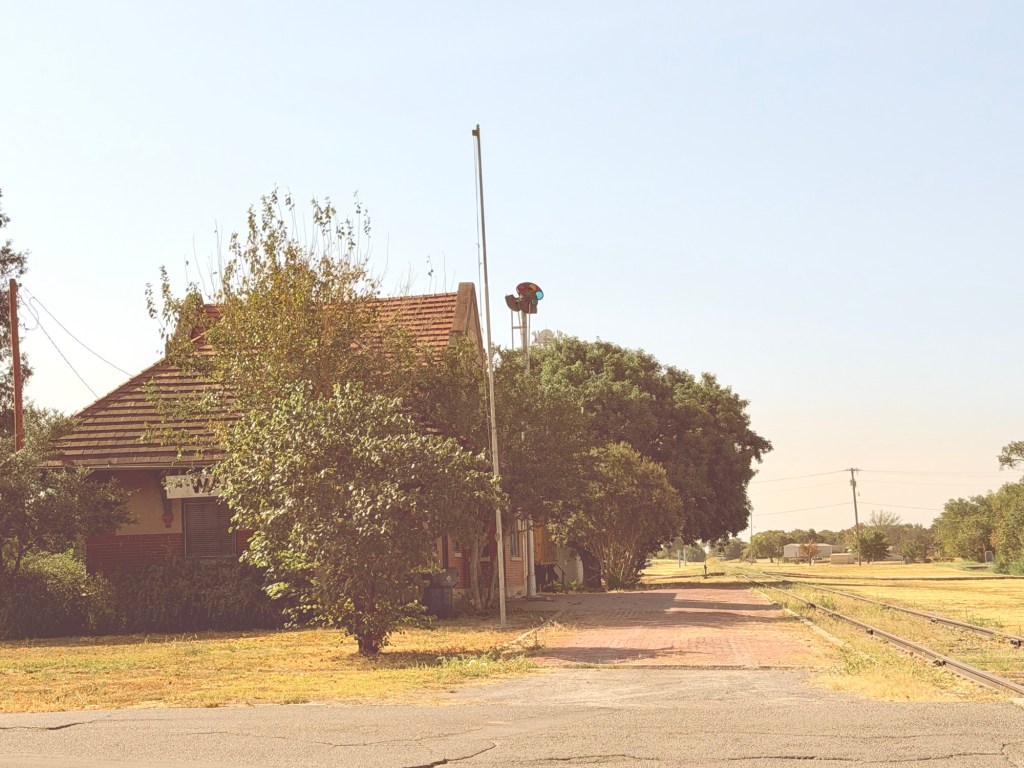
Back in Walters, I live about a block from the old train depot. Built in 1920, the Rock Island Depot put Walters on the map in Cotton County and heavily influenced the town’s selection as the county seat. The line itself served primarily as a local passenger stop along the Rock Island and Pacific Railway line – although the tracks eventually linked up to points well beyond the confines of Cotton County, particularly once one reached Oklahoma City or Dallas.
Today, the depot is on the National Register of Historic Places. It mostly hosts community art events and is home to a newly-minted playground for the kiddos in town.
I guess one could say its heyday has long passed. But it’s still interesting to think about the people that boarded and disembarked all those trains back in the day. The passenger line ran until the 1950s before cost cuts closed the local lines, opening the tracks to mostly freight (viz., grain) until the depot’s ultimate closure in 1980. Sometimes when I walk by, I think about the age when train travel was a major form of transportation. Folks boarding and waving good-bye to loved ones on the red brick walkway outside. Perhaps soldiers going off to war or returning from battle. Thousands of lives lived and now long gone, even while the building remains – a testament to life in a different era.
I sometimes wonder about the lives of those people. What their goals were. What they dreamed of accomplishing. The people they were dating. Who their friends were. What they did for work. What they did for fun. How did things turn out for them.
That kind of wondering has a way of raising larger questions. Lately, I’ve been reading about different schools of psychology and the great debate between Freud’s etiology and Adler’s teleology, and the contrast keeps returning to me. As a former, law-trained academic, I’m out of my depth, but the difference is clear enough. The rub of Freudian etiology looks to the past as a way to explain current behavior. Meanwhile, Adlerian teleology looks to purpose and what a particular behavior is trying to achieve, and whether that purpose can be redirected toward more constructive ends. To a layman like yours truly, the differences seem like an exercise in semantics. But they’re actually quite distinct.
In Freud’s world, people are the way they are based on their past. And the way to address the present is to work through what has happened in the past. In Adler’s world, a person’s past is irrelevant. What matters is the goal a person is trying to achieve through a behavior, and how to redirect the individual toward a more constructive goal. Freud asks, what happened. Adler asks, what’s the point.
The link between etiology/teleology and the depot actually gets back to an ancient question that was also posed by a lawyer to Jesus: “Who is my neighbor?” While the depot itself is surely in the neighborhood, I can’t properly call it a neighbor – no matter how compelling the depot’s past may be to Freud. Adler, by contrast, would say the history of a building and its former patrons really isn’t that important. What’s more important are the interpersonal relationships I have with the people around me right now. In other words, my actual neighbors are all of the people who live in my vicinity. My neighbors are the people I worked with. My circle of friends. My family. My child. My person here in Colorado. Location doesn’t matter so much as the depth and breadth of the interpersonal relationships that make up my life.
And I think that’s a good thing. Perhaps I am, by nature, much more Adlerian than Freudian.
To me, dwelling on the past only accomplishes so much. The real question for each of us is, “what are we trying to accomplish in the limited time we have on this earth?” I think when we put life in stark contrast to the ticking clock that I’ve alluded to in other posts, it makes one acutely aware of the need to treat each moment as an irreplaceable gift.
Maybe that’s the point. It’s fine to think about the people who have come and gone from the old depot. It’s okay to wonder about their lives and even about what life was like way back when. But that’s not the same thing as loving your neighbor. Loving your neighbor requires active participation. It’s contemporaneous. It requires an investment. And even as frightening as investment can be, even a failed investment of time, love, energy, and effort is better than having never left the past.
So, I think Mr. Rogers said it best: “Won’t you be my neighbor?”


Leave a Reply