Author: Tory Fodder

  • Country and Culture

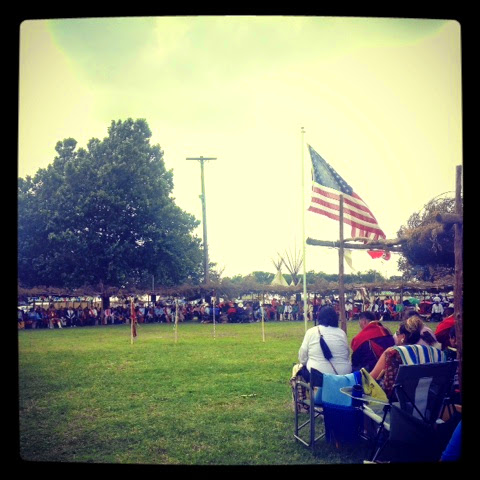
    I’m writing today from steamy Carnegie Park, home of the Kiowa Gourd Clan’s annual celebration. While an American flag is prominently displayed in the middle of the arena and scores of veterans line the rows of chairs behind it, the event is decidedly not a celebration of America’s Independence from Great Britain. 

    Somewhere around the time that the Kiowa Indians came to call this part of Oklahoma home, the early days of July coincided with the ripening of the skunkberry, indicating that the time for holding the sun dance was near. As Kiowa warriors came to defend their territories in the infamous “Indian Wars” against the U.S. Cavalry in the late 1800s, trophies of battle were proudly displayed in the literal center of the annual ceremony. Given its origins, the event became more a celebration of tribal insurgency than a celebration of American Independence from European powers.

    Yet, it is impossible to discount the appreciation for our country here marked by a plethora of red, white, and blue, along with the deep admiration expressed repeatedly for the young men from Kiowa Country who have fought with honor on distant shores. It’s also noteworthy that Native Americans have the highest record of military service per capita of any ethnic group in the United States. It is fair to say that American Indians are a rather patriotic lot all things considered.  

    But if there’s a conclusion to be drawn from the Kiowa Gourd Clan celebration and its implications for the nexus of culture and country, it is that America’s relationship with its tribal nations is rife with complexity. And though it may be surprising, it is exactly this complexity that makes the annual celebration here in Carnegie a quintessentially American affair.

    A couple of years ago I wrote that America is like a large dysfunctional family. I think this is still mostly true. Consider the hullabaloo surrounding the Supreme Court’s recent Hobby Lobby opinion. Proponents of Obamacare and those who generally support the mass availability of contraception have bemoaned the “dangerous implications” of the Supreme Court’s “radical” decision. Meanwhile, faith-based organizations and those opposed to family planning have hailed the ruling as a profound “victory for religious freedom.”

    Given our divide, it’s clear that both our internal relationship with other Americans, and America’s relationship with tribes, are complex things. And yet, like a marriage on the rocks, America somehow manages to hold it together year in and year out, providing relative stability for the world and bags of cash when good will isn’t good enough.

    It’s true we can do more to cooperate and solve big problems. We can be more united and less inclined to bickering. But as a society we seem to hold our collective paradox rather well.

    With our population so divided on so many issues, perhaps celebrating our cultural disconnects really is the best we can do.  

  • Secular Thoughts and Sacred Conclusions

    10314567 10100264830908536 442351989054637203 n

    It’s a quiet morning here on the farm. My Wife, Son, and Grandfather have all made the trek down the road and up the steep hill to church. I’ve opted for a somewhat less holy morning of coffee and Emails. Not nearly as uplifting but we all have our spiritual needs I suppose. 

    Despite my morning of zen, a lot has happened in the past few weeks. Most recently, my baby sister graduated from high school, thereby ensuring my parents an empty nest if they ever permit her to leave. For now, her college plans include attending the local university and commuting from home at their insistence. 

    For my friends and colleagues not from Southwest Oklahoma, the graduation ceremony itself would have been somewhat of a surprise. Like the one hundred and five Walters High School Commencement ceremonies before it, my sister’s graduation was punctuated by very public references to God and Jesus with one precocious valedictorian going so far as to share the gospel from rostrum, complete with pastoral inflections and Biblical passages. Naturally, he was a preacher’s kid – the scion of the First Baptist Church minister no less. As if this weren’t enough, the baccalaureate service was also prominently advertised, directly opposite the graduation agenda on the official programs issued by the school. It was enough to make even this God-fearing agnostic’s head swirl. Suffice it to say, Jefferson’s wall of separation between church and state is in a bit of disrepair around here. 

    On the other hand, such a melding of faith and state wasn’t all bad. After a spirited debate with the powers that be, my sister managed to secure permission to wear an Eagle plume feather from her mortar board. Granted, the permission didn’t not come readily or perhaps even willingly, but we were all pleased nonetheless that the situation didn’t escalate. Last year, a Native American high school senior from Alabama was fined $1000 for her exercise of religious expression. The matter would have been especially ironic given the overt displays of religious expression throughout the ceremony. Perhaps the event will mark a new era of religious pluralism here in sleepy Walters, OK?

    First Amendment questions aside, being home has been rather nice in other ways. We returned to America unexpectedly at the conclusion of my contract with the University of Waikato at the end of March. Fundraising had been a perennial problem for my employer, the University Waikato’s new Indigenous Governance Centre. But as you can see in the photo above, we returned to warm temps and mild summer evenings that provide ample time for walks down the narrow lane leading to our house. I enjoyed similar walks with my Son in New Zealand, but the area around our flat didn’t have the quiet, peaceful environs we enjoy here in the country. In a way, the biggest benefit to being home is how simple it really is. 

    While I poked a bit of fun earlier at the overt religiosity here in the veritable buckle of the Bible Belt, there is something to be said for the stability and simplicity of life gleaned from the faith that guides most people around here – a faith I once had. This is particularly true when one considers the relative chaos that seems to pervade everything else.

    Consider that in just the past week alone, people much more tech savvy than myself have said that the security infrastructure of our computers and computer systems is “held together with the IT equivalent of baling wire.” Similarly smart people have questioned whether the crisis in the Ukraine could lead to another World War. And not long ago, closer to home, our State so thoroughly botched the execution of a man that he died of a heart-attack some twenty minutes after state officials halted the entire process.

    Given such a comedy of errors, it’s nice to have a place that’s insulated from the madness – if only for a short while. But more on that to come.

  • Three Grains of Sand

     
    We’re seaside in Raglan, New Zealand today. The air smells of salt, and the sand is warm beneath bare feet. 
     
    Our hosts today are a delightful Italian couple that we’ve become friends with through the University. It’s an adventure traveling the countryside with them. We are driving an early 2000s model sedan with a manual transmission. It hasn’t always been a smooth ride, but something about the fits and starts of the tired engine make the trek to the coast seem more appropriate. 
     
    We had lunch earlier at a lovely, albeit overpriced, fusion cafe. The shops of Raglan were bustling this afternoon with locals and tourists alike. In the cafe, I had a chicken roti wrap that tasted rather like a quesadilla with bacon and potatoes than a proper wrap. The local beer on tap was a bit bitter even for me. But it was cold and wet, and that made it just good enough to satisfy my thirst before our trip to the beach. 
     
    The roads to the shore from the village green weren’t obvious. They tend to wind and meander along the cliffs and neighborhoods of the town, while the shore remains hidden just out of view. But after a couple of turns, we saw the sea gleaming far below the ridge. 
     
    When we finally arrived on the sand not long ago, Clark immediately made a straight line for the water. Kids seem to have a fixation with water that I no longer appreciate as an adult. Still it’s a beautiful love he has for the ocean. Perhaps if we lived here longer he would learn to surf, and fish, and swim in the sea. 
     
    It’s strange to consider that we’ll be returning to America in the near future, leaving New Zealand and the black sands of Raglan far behind. It’s time to go home, I think. But for Clark’s sake, I hope we visit again sometime. We have too many friends here to never return. 
     
    It strikes me that so much of life is like this. The three of us in isolation are like three grains of sand taken from a vast beach. We can exist just fine on our own, but we tend to thrive when in the company of the countless others that make life worthwhile. 


  • The Solitude of a City

    It’s been a while since I’ve lived in a proper city. This evening provided an unexpected reminiscence when I found myself flying solo in downtown Auckland. 
    It was a steamy day here in Aotearoa. The humid air mixed with the sounds of traffic and exhaust. For a moment, I was taken by the ghost of summers past, back to long days spent in Washington, DC, beating the pavement between Union Station and the Capitol. 
    When the heat became too much, I stopped at a faux Moroccan bar and grill called the Casablanca. I ordered a pilsner to spite the heat and a Moroccan-style pizza. It wasn’t a very memorable meal in all honesty. But my spot along the street was prime real estate for people watching. There was a fine breeze kicking between the buildings. 
    Sipping my beer, I thought about the topics at the seminar I attended. Experts, mostly from New Zealand and Australia, gathered to discuss the plight of Indigenous peoples’ access to justice. It was all rather depressing to hear their accounts of discrimination, and abuses of discretion despite the supposedly blind  nature of lady justice. 
    Which is an important lesson really. If one is ever in need of a pick-me-up, seminars sponsored by the various U.N. Expert Mechanisms are not the solution. 
    As I watched people and wondered about their lives, it struck me that the city can be a damn lonely place. Not a new thought. But an important one all the same.  
    When I finished my meal, I paid the waitress and left, searching for colleagues and camaraderie. All told, I think cities are best defined as bastions of solitude comprised of thousands upon thousands of souls. 
    Personally, I’d rather be at home with Gwyn and Clark. Our place isn’t much. But it’s never lonely. 
  • Analyzing Excellence, Part II

    Courtesy of the AP / Photo by Ben Liebenberg

    When I wrote the piece on excellence yesterday morning, it was well before Peyton Manning and the Denver Broncos suffered an epic collapse in one of the most lopsided losses in Super Bowl history. During the 4th Quarter of the game, infamous Seahawks cornerback Richard Sherman left the game with an ankle injury and did not return.

    What makes this blip on the Super Bowl radar interesting is that in the weeks prior to Super Bowl XLVII, Sherman made it a point to repeatedly criticize Peyton Manning’s passing abilities. At one point, he compared his throws to wobbly ducks languidly flying through the air. To his credit, Manning brushed off the comments during the week and moved on to other things.

    Fast-forward to yesterday’s game.

    The Broncos had just taken a drubbing and the media circus was already in full swing, documenting the aftermath, and dismissing the Broncos performance as an NFL embarrassment. If anyone could justify going off the grid, after a loss like that, it’d be Peyton Manning.

    So what does he do?

    He trudges down the winding corridors of MetLife Stadium, the sting of defeat still burning his eyes. He by-passes the Seattle acolytes celebrating their victory at his expense. And Peyton Manning calls on Richard Sherman, the man who had excoriated him in the media weeks earlier and defeated him on the field moments ago, to inquire as to his health and make sure that he was okay. ‘Ankle injuries are serious things. Just making sure you’re ok.’

    You see, when you’re excellent, it doesn’t really matter whether you win or lose.