Tag: Travel

  • Winter Books Reviews – 2013

    IMG 0872

    It seems no sooner did I resolve to post more often then the first week of the new year slipped away.

    Much is afoot here in the Sooner State. My family and I are planning a temporary relocation to New Zealand (more on that later) and it seems like the paperwork for our visa applications will never end.

    Closer to home, I am planning three book reviews for the winter months – all of which look quite promising. Here’s a brief run down of coming attractions:

    Ron Rash’s The Cove debuted in the Spring of 2012. The paperback came out recently, reprinting the haunting tale of an outcast girl, and a mysterious wanderer who happens upon her isolated homestead.

    Alexander Snegirev’s Petroleum Venus is set for release next month. The book is on he shortlist for the Russian National Bestseller Prize. The novel depicts the relationship between a single father and his soon who was born with Down’s syndrome.

    Finally, Nell Leyshon’s The Colour of Milk was released in late December. The slim book explores the temptations of a young father’s daughter as she leaves the family farm to work for an aging couple living nearby. The young girl is introduced to knowledge of the intellectual and carnal variety as she is forced to grapple with the consequences of both.

    In all, a busy schedule but one that hopefully generates many more conversations to come. As always, stay tuned.

    – Posted using BlogPress from my iPhone

  • Boston and Blue Skies, Smiling At Me

    Boston

    This post finds me sky high above the charming hamlet of Detroit, MI, which is yet further proof that beauty is in the eye of the beholder.

    As with most Southwest Airlines flights, the aisles run six across and passengers are stuffed into their seats like fat sardines. However, one of the saving graces of this flight is Southwest’s relatively inexpensive access to the internet. Of course, at $5 per flight, the internet connection is maddeningly slow, prompting an unexpected yearning for the good old days of dial-up.

    Chalk this one up to first world problems, I suppose. 

    My travels today ultimately take me to Boston, a city that I have not visited since July 2007. What strikes me about my return to Beantown is how much life has changed. In the city I once called home, I now know almost no one. The friends who once feted my departure are now distant ghosts themselves, having long since moved on to warmer climes.

    The thought reminds me of just how transient life is in one’s twenties. At risk of extrapolating too much from my surroundings, one’s twenties are a bit like all of the passengers stuffed together in this plane. Some people make the most out of a location by finding new friends. Others hunker down and get to work. Some keep to themselves. But the lone commonality that all share is the simple lack of attachment to the particular place. The landing of a five hour flight has a funny way of dispensing with sentimentalities. And that’s how Boston was for me at age 24 – a lot of fun, but completely void of a reason to stay.

    It’s true that I’m not quite thirty. But being married with a dog and a child on the way, and grad school now well behind me, I can’t help but feel a bit older than I am. To be clear, I would not reverse the clock. Living in “The Hub” made for a fun couple of years, but when I left it was more than time to put away childish things, as they say.

    Still, reminiscing does make one appreciate the carefree days of youth – when my biggest concern was making weekend plans, and my most pressing dilemma was whether to visit the gym on my lunch break or not. If only I had made the visit more often… 

  • The View From the Top of the World

    Some eleven years ago, Vanity Fair contributor Bryan Burrough wrote a lengthy, if not macabre, article about the disappearance of a pair of mountaineers who were attempting to become the first individuals to summit Mt. Everest.

    The two were an odd pair. The leader of the 1924 expedition was renown British mountaineer George Mallory, who was making his third and final attempt to reach the top of the world. His partner was an accomplished, yet comparative neophyte climber named Andrew “Sandy” Irvine. The trek up Everest was Irvine’s first.

    As the duo braced for the final push, ascending the mountain’s infamous “second step,” fellow mountaineer Noel Odell spotted the two in the distance:

    From what Odell could see, they had barely 900 feet to go before they reached the summit. Then a veil of high white clouds dropped across the mountaintop, obscuring Odell’s view, and the two men disappeared.

    Forever.

    [Link]

    The fate of the two men, and their success was a complete mystery, left shrouded in Everest’s icy mist until May 1, 1999, when a gaggle of American climbers found the proverbial needle in the haystack on Everest’s icy slopes, and discovered the body of George Mallory. Whether Mallory and Irvine actually reached the summit remains unclear.

    Burrough’s tale is, of course, gripping. He describes Mallory and Irvine’s ascent through the “death zone” of Mt. Everest, and explains the remarkable odds faced by climbers who challenge the angry mountain.

    Since Everest was first conquered by Sir Edmund Hillary in 1953, roughly 219 people have perished in their attempt to follow suit. The death of Francys (Fran) Arsentiev is a particularly harrowing account. Arsentiev was an American climber who was discovered alive though ailing on the mountain by a group of climbers. After assessing Arsentiev’s condition, and the weather conditions on Everest, the group left her to die as they made their ascent.

    The accounts and documentaries on the difficulties of summiting Mt. Everest, leave me utterly entranced by the human need to accomplish. We homo sapiens seem to have something hard wired in us that cuts across cultures, and prompts us to test our limits. In the Arsentiev story, climbers saw the risks that awaited them, yet left her to pursue their climb anyway. A more callous interpretation of the story is that the climbers’ need to reach the summit trumped their concern for human life, sentencing Arsentiev to death – though the matter is admittedly much more complex. As for Mallory and Irvine, climbing in 1924, they were attempting the impossible. Everest had never been climbed. Their gear consisted of woolen jackets and hobnail boots. The odds of success had them doomed from the start. And yet, they climbed. Some theories even have Mallory actually summiting before his death – a full 29 years before Sir Edmund Hillary.

    Mallory reputedly said he wanted to climb Everest simply, “because it’s there.” Whether the quotation is true or not, it aptly sums up a great deal about the life we live. Why did mankind go to the Moon? What prompted our scientific advances in medicine? What made Steve Jobs and Steve Wozniak create the Apple I and Apple II computers? What makes an otherwise sane person pursue a doctorate (in any field)? What makes a group of disgruntled taxpayers think they can defeat the most powerful nation on Earth? Why do we set New Year’s resolutions, run marathons, smoke cigars, play video games, or create works of art, literature, and music?

    In the end, all of our creative and aspirational undertakings amount to some variation of Mallory’s “because it’s there.”

    I doubt that I will ever climb Mt. Everest, but knowing Mallory’s story leaves me with the inkling there’s something fundamentally human about the view from the top of the world. It’s in our DNA. It’s the feeling everyone gets when we conquer our respective mountains – literally, or figuratively; wherever, and whatever they may be.

  • A Dispatch from Taos

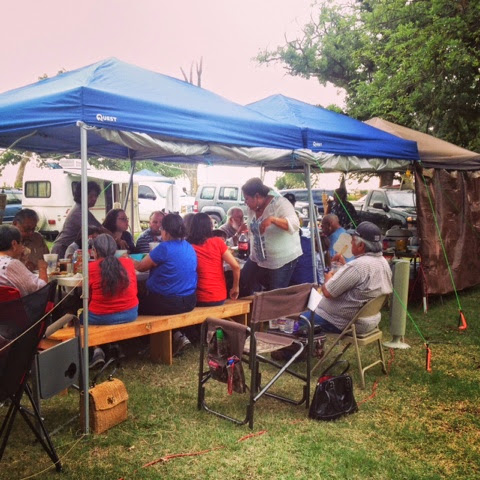
    It’s a drop past 11AM here in Taos Pueblo. The temperature has languidly paced it’s way into the 50s. A cool breeze makes its way beneath the carport here at my Grandmother’s house.

    It’s mid-October, but wood stoves burn in the distance, and the smells of piñon waft through the air as it has done for centuries in this ancient, mysterious place.

    There’s a shed across the dirt driveway. It is filled to the top of its 9-ft tall ceiling with enough wood to last two winters. I suppose the excess is important during the cold winter to come. But I’ve never seen the wood shed at less than capacity during any season.

    Maybe that’s the point. The cares and concerns here are about history and routine. Irrigating. Agriculture. Fishing. Hunting. Home repair. Tradition. Custom.

    In most respects, Taos is a full-throttled embrace of the historical. This disposition allows for language and tradition to coexist alongside the western/anglicized City of Taos less than a mile away.

    Naturally, this makes a balance with the unhistorical nearly impossible, as Nietzsche would say. Living in the moment, living for self, and the now are supreme challenges for Taos Pueblo and its denizens. Western arts, culture, and technology (aside from the ubiquitous Chevy trucks) are scarce on the reservation.

    Yet, as the leaves rustle, marking the passage of time, it’s a comfort to know that places like Taos still exist. Off the grid. A shrine to history.

    A place where time stands still.