Author: Tory Fodder

  • Tales from the Road


    IMG 0747

    Today finds me encamped at the local Denny’s here in Joplin, MO. My wife and I are en route to Bloomington, IN for Thanksgiving with her family. The place is filled with travelers taking a break from the grind along I-44, hailing from all walks of life.

    Our waitress is a friendly sort, coming from good, Midwestern stock. She’s friendly but not overly so and seems to execute her job with a refreshing efficiency.

    There’s an interesting gaggle of locals perched at the bar watching TV, sipping coffee without a care in the world. It’s a bit like a throwback to the cafes of old, when the coffee was strong and the people were stronger. The men wear blue jeans and baseball caps while the lone woman dons a Sons of Anarchy t-shirt. I can’t comment on their sartorial choices but the camaraderie is impressive. They clearly all know each other and the scene I am witnessing has repeated itself numerous times before.

    Our son Clark was hungry and angry a bit earlier. As my wife rose to make a hasty retreat for the baby changing station in the adjacent Flying J Truck stop, we received a number of sympathetic nods from our fellow customers. We replied with appreciative smiles.

    When I looked at Clark’s empty carseat, I couldn’t help but appreciate such a place that brings so many disparate people together. How strange to find community while randomly traveling down the road.

    – Posted using BlogPress from my iPhone

  • Book Review: The Accomplice

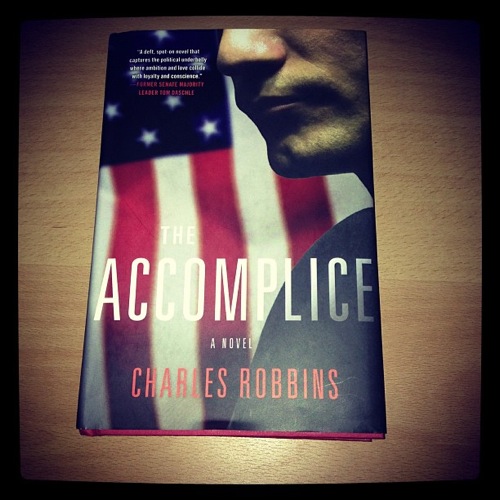
    TheAccomplice
    One of my many, minor vices is the thriller/mystery novel genre. Turning the dial back to the 5th grade, I remember reading the complete works of Sherlock Holmes and shattering the “Book It” records for my classroom. If memory serves me correctly, this also sparked a lifelong fascination with Pizza Hut pizzas.

    More recently, the works of Brad Metzler and to a lesser extent Elizabeth Kostova, Dan Brown, and Ken Follett, have all captured some of my early forays into reading. Each author spins a yarn that can rival the latest blockbuster movie, while most importantly leaving me unable to put the book down. Having read Charles Robbins’ debut novel The Accomplice (Publisher: St. Martin’s Press/Thomas Dunne Books; On Sale: Sept. 4, 2012 ; Cost: $24.99), I’m pleased to have discovered an author with a similar gift.

    For those outside the I-495 Beltway (that is to say the honest people of our great and blessed land), Charles Robbins is a former Congressional staffer and communications director for the late Sen. Arlen Specter’s ill-fated 1996 Presidential bid. His novel explores “what happens when ambition and power meet in the midst of a world filled with ruthless characters willing to do whatever it takes to win” – which basically means sex scandals, corrupt politicians, and backstabbing campaign operatives. Hope and change, indeed.

    Being somewhat of a very minor, ex-politico, the subject matter was intriguing from my first glance at the press release. Political types tend to be a fairly incestuous brood, and no matter what one’s scruples, it seems that everyone loves a good political sex scandal. Just ask Mark Sanford.

    Robbins captures this appeal to the prurient interest in a way that is eminently consistent with good storytelling and political intrigue. From clandestine meetings with vulnerable campaign volunteers (p.113), to cozy luncheons with the candidate’s wife (p.241) (Which, incidentally, takes place at Piccola Italia restaurant in downtown Manchester, NH – home to the best broccoli, chicken and penne I’ve ever eaten), Robbins takes readers into the seedy underbelly of major political campaigns where ethics and idealism meet realpolitick.

    The plot is, of course, much more interesting than salaciousness for its own sake. Drawing from his political background and his bygone days as a print newsman, Robbins’ tale is also rich in the details of internal, campaign subterfuge, pitting the objectives of campaign bosses against the pseudo-power of local party elites (p.259). By the time Robbins winds up his thriller, a murder and a financial scandal have embroiled the once idealistic staffer who serves as the novel’s the main character.

    Naturally, I realize that the plot summary above (which purposefully tries to obscure anything that might give away the ending and any important subplots) does a supreme injustice to the actual writing and the work itself. This highlights, I think, a basic tension in the mystery/thriller genre itself – whether a work is defined by its plot or by its pace. The former requires a great deal of focus on the events of the novel and the characters that appear front and center throughout. Novels defined by their pace, on the other hand, tend to move confidently ahead, pulling readers to the next line, paragraph, and page almost involuntarily. These are the kinds of books that you can read into the wee small hours of the morning and never miss that the world has long been fast asleep.

    It should be obvious that Robbins’ work hails from the clan of books defined by their pace. Those seeking exquisite prose would do well never to open any book in this genre but this is particularly true of Robbins’ debut piece. The language is coarse yet purposeful. Almost utilitarian. As if the words themselves are a hinderance to the story being told in the mind’s eye.

    Robbins’ idea is not to wow readers with his doubtless, ample Princeton vocabulary. The goal is to suck readers into the abyss of campaign life and the ethical dilemmas, or lack thereof, facing all those who dare to enter Roosevelt’s arena. This makes it very easy to become absorbed in the story and to stalk the dank hotel rooms of the campaign trail along with Henry Hatten.

    In all, the novel is a timely release, particularly with the election taking place today. For the political junkies and mystery enthusiasts among us, Robbins’ tale will fit nicely into a fall reading list. My view from the cheap seats is that it’s an excellent read from an engaging, new author. Here’s hoping Mr. Robbins’ first work is not his last.

    – Posted using BlogPress from my iPad

  • Book Review: The Book of Neil

    The Book of Neil

    But for the kindness of my friend Meryl Zagarek (http://www.mzpr.com), it’s quite likely that I would have missed the release of Frank Turner Hollon’s latest novel, The Book of Neil (Publisher: MacAdam/Cage; On Sale: Nov. 16, 2012 ; Cost: $20.00). As a bit of reference, Mr. Hollon is a prolific author of children’s books and short stories, but one who also boasts two novels that have been turned into films (Barry Munday; and Blood and Circumstances, which is currently in production). I think it’s safe to say that Hollon’s novel will not be remembered for its prose, which is at times repetitive and understated. But the novel’s staying power is its exploration of a complex theological question, using an extremely minimalist writing style.

    The theme of Hollon’s novel centers on the proposition of Christ’s return to earth in the age of Facebook and Twitter. Here’s how the press release describes Mr. Hollon’s work:

    In The Book of Neil we are asked to consider what would happen if Jesus returned to earth in 2012, at a time when people are driven by consumption, self-indulgence, and a preoccupation with social media. Are we so cynical that Jesus would be dismissed as just another mentally ill street-preacher?

    The idea is striking because the return of Jesus to Earth is one of the few aspects of Christian theology that mainstream Christianity tends not to debate. These days, our theological and moral disputes tend to include issues like determinism, theodicy, Biblical inerrancy, literalism, gay marriage, abortion and once upon a time questions about stem cell research and the like. But these issues are more on the periphery and clearly not central to the tenants of Christian faith itself (viz., Christ’s return to Earth).

    So, what would it look like if Jesus came back to Earth, say, today? How would the event unfold? What would the reaction of believers be as opposed to the reaction of non-believers? Hollon’s novel offers readers his interpretation of the answer.

    What’s obvious from the first page is that the work is no typical novel. Hollon’s writing style is minimalist to the point of distraction (more on this later). His characters are sketches of what characters should be. The details Hollon provides are sparse. Days bleed into one another without paying heed to the logical progression of time. In this way, Hollon’s work is not a cheap knock off from Joyce, focusing on the minutia of the day to day. Instead Hollon’s style keeps the focus on life’s panorama of the forest. The big picture accented by big themes. 

    The first theme readers encounter is Hollon’s embrace of absurdism, which not only provides the justification for Hollon’s experiment but also paves the way for some of the other ideas explored in the work. Absurdism suggests that human efforts to divine meaning are absurd on their face because the exercise is impossible and doomed to fail. Absurdism’s implausibility of truth justifies the minimalist introduction to the work beginning on page 1 of the novel. There, Neil casually meets Jesus on the 14th hole of the local country club. After exchanging pleasantries, Jesus notes, “You’re probably wondering what I’m doing here.” Without waiting for an answer, Jesus replies:

    “I’m playing golf,” He said. “A frustrating game. I don’t really have the patience for it, but I enjoy playing anyway.” p.11.

    Aside from being a bit presumptuous, Jesus’ opening line in the work is rife with absurdity because of how mundane the introduction actually is. It’s a bit like an off-Broadway production of Seinfeld, a scene about nothing using next to nothing to make the point. Hollon’s early pages make the search for meaning futile because they take place on the blandest of all locales to which the Son of God could possibly return. To make the point even more pronounced, Hollon fills the mouth of God Incarnate with the same, tired clichés about golf uttered by every other hack with a set of clubs.

    This absurdist framework creates a justification for everything that follows. Specifically, Hollon can continue his experiment because it is not a search for meaning. Rather it is an exercise in potentiality, an experiment illustrating what could be. There is no deeper truth to Hollon’s work because it is a hypothetical, and searching for the Truth in a hypothetical is folly because hypotheticals are by definition works of fiction. 

    Of course, the book would be relatively short and uninteresting if page after page of the work recounted the folly of man’s search for meaning set amid scenarios and scenes that have never happened. Almost of necessity, Hollon’s embrace of the absurd requires him to explore the implications of his premise which is by far the more interesting exercise of the novel. This analysis begins with the simple observation that a world void of meaning presents a rather large opening for individuals (and ultimately society) to descend into nihilism. 

    The book’s eponymous anti-hero Neil describes the matter as follows:  

    It’s the never ending balance. On one side is the absolute knowledge that nothing whatsoever matters. There’s nothing any of us can do, nothing, that makes any difference at all. The world will continue to spin, time will continue to run, and each of us, every single one of us, will die, go back into the earth one way or another, and be forgotten in the blink of an eye.

    On the other side, we wake up every morning and convince ourselves how important it is to provide for our children, bring the dog inside when it’s cold, mow the grass, pay the electric bill. And we ignore the irreconcilable differences between the two, the dichotomy. How can we not? Utter hopelessness is only a thought away, and the dogs are at the door. p.123

    If we grant Hollon his absurdist introduction, then Neil’s summary of the matter is the natural result. Throughout the novel, various characters struggle to make sense of Jesus’ return, and invariably this forces them to evaluate the mundane and traumatic in their lives vis-à-vis the hope that life itself is not absurd and void of meaning. Much like he does in the New Testament, the figure of Jesus brings hope to individuals that takes them beyond the nihilistic conclusions of absurdism, and beyond the empty existentialism of crafting a subjective meaning from life’s routine.

    Hollon uses this otherness of Jesus to advance the majority of his novel’s plot. Readers see stories of individuals demonstrating the effects of Jesus’ return on the micro-level. As the scenarios play out in the characters’ lives, this has the effect of rescuing hope from the clutches of the absurd in the novel. Some of the characters find hope and inspiration through Jesus’ return. Others are forced to confront whether they believe in an alternative to nihilism and the existential routine of truth as subjectivity. 

    While the novel is rich in major themes and presents nearly all of them in a sophisticated manner, the emphasis on big picture has the effect of diminishing Hollon’s prose. This is not a novel to read if you long for the descriptions of Tolstoy or the punch of Hemingway. Hollon does not pretend to be anything other than what he is: a thoughtful writer, intrigued by the ideas of his work. But as a result some of his prose suffers. Portions of the novel are repetitive. Phrases, jokes, witticisms all make more appearances than necessary. And to be fair, most of the characters lack depth. We learn little of their backgrounds, aspirations, and even motivations in some instances. But this is deliberate. Prose, character development, and style are all sacrificed for Hollon’s experiment with big concepts. The novel is bold in this regard even though this quality could easily be off-putting to the casual reader. 

    Still, it is Hollon’s boldness that makes the work a success. For all of its faults stylistically, Hollon’s insistence upon exploring big ideas more than makes up for the novel’s ultra-minimalist style. The question going forward will be whether Hollon’s hard work and focus on the forest will find success in a culture and readership that is increasingly more interested in the trees. 

  • Fatherhood: First Impressions

    Baby Clark

    This past Monday, on October 15, 2012, after a protracted, thirty-hour labor, Gwyn and I welcomed our first-born son into the world. Clark William Fodder was born at 9:52 AM here in Tucson, weighing in at 7 lbs on the nose. It’s strange to think of instantly loving a child, but the parenting instincts really kicked in without a problem. A few years ago, I called children parasites, as of Monday I called this one my “little buddy” and my Son. Naturally, much has changed in the past week. 

    As a quick example, it’s about 12:30AM on Sunday night as I sit down to write this. Clark is snoozing in his bassinet, a structure I am very much tempted to call a crate à la our Pooch Alexas. Though the hour draws late, it’s really only the beginning of my night. In a surprise to no one but me, late nights over the past week have delayed my ability to do much of anything. So many friends and family had warned us about the coming dearth of sleep but I stubbornly assumed that any spawn of mine would prove the exception rather than the rule. The result of tempting these fates is that Baby Clark seems to have inherited, in manifold, my penchant for late nights. This party is just getting started.

    Clark’s typical “night” includes waking up around 11PM/12AM for dinner. After 10 to 15 minutes of feeding, he falls back asleep for an hour or so, before waking up for yet another meal. The scenario repeats itself until around 7AM when he finally drifts off for good until breakfast around 10AM. Sleep for me and Gwyn occurs between feedings, leaving us in a zomboid trance most of the day, mindlessly wandering between Clark’s crate and the kitchen in search of coffee (brains!). 

    The Mayo Clinic actually offers a number of helpful tips to soothe the disconsolate newborn, but at 4AM our ability to think rationally is usually fairly well gone. I find that I’ve developed a number of superstitions to help me cope with the uncertainty. My ritual when putting Clark to bed includes gently placing him in the bassinet and gingerly walking backwards as if the slightest wrong move might trigger the baby bomb’s explosive mechanism. And when Clark successfully remains asleep, James Bond has nothing on this sleep deprived father. 

    I’m not sure that my rituals help but like so many tricks of parenting, they impose a bit of order on what is in reality a muddled process, adding structure to something that is utterly beyond my control anyway. This is the hardest part of being a parent really. Nothing and everything is simultaneously within my control. As first-time parents, there are any number of things that could go wrong at any point and none of these exigencies are within my ambit of control (illness, acts of god, diapers that don’t quite keeping exterior clothing dry, etc.). And yet all of the choices related to Clark’s rearing are within my control (selecting a pediatrician, purchasing a safe car seat, buying a different brand of diaper, etc.). It’s really a maddening dichotomy when you think about it.  

    The crux of what I’ve learned in the past week is that the only way to navigate the contrariety of Fatherhood is give it the old college try. Do the best you can. Give it a go. “Keep Calm and Carry On” as the meme says. But don’t get caught in the lie of believing that there’s a best or even better way of doing things. For every opinion given, there are completely different schools of thought that say the opposite. So, just pick one. Everyone who has ever parented a kid and whole segments of the population who haven’t, seem to have theories about the best way to swaddle a newborn. Accordingly, there are no less than ten different websites selling wares meant for swaddling newborns, with each company claiming to sell the best product for swaddling (and let’s be honest, the Miracle Blanket is really the best product on the market). Yet, the same act can be accomplished by a bit of folding trickery with a receiving blanket, $10 for a pack of 4 at Target. There’s no right way. Just your way. 

    Anyway, in case you missed the lead I just buried, the point is just that there’s really no right, better or best way to rear a kid. This realization makes me appreciate the decisions that my own parents faced when I was a child. And in retrospect, I have to say that most parents (mine included) end up doing a pretty good job – even when they’ve had to turn chicken shit into chicken salad.  

    And so, with already 6 days on the job and roughly 6,564 days until Clark turns 18, as the hymn says, time is now fleeting, the moments are passing. Here’s hoping that when the bell tolls, we’ll have done a pretty good job too.

  • Thoughts of an Anxious Father

    An Anxious Father

    “The people of long ago are not remembered, nor will there be any remembrance of people yet to come by those who come after them.”

    – Ecclesiastes 1.11

    We had our weekly doctor’s appointment today. I’ll do my best not to reveal too much information although this is surprisingly difficult to do when discussing a pregnancy. In brief, Gwyn is progressing quite well and is nearing the stages of early delivery. In terms of timeframe, Baby Clark could arrive any day now. 

    Being the eternal ray of sunshine that I am, his birth triggers a lot of conflicting thoughts for me. Naturally, I’ll start with the more melancholic.

    I suppose I turned to the passage above from Ecclesiastes because it reminds me of our collective lot, set amid the vast pantheon of begins who have lived and died on this terrestrial plane, and are now forgotten. Thinking of my son, I want him to exceed this very low bar set by Ecclesiastes. I want his life to have meaning. I don’t want his name relegated to the dusty annals of history. I want him to be…great!

    Of course, greatness, by definition, is rare. When I think of the great men of history, I think of Jesus. Thomas Jefferson. John Locke. Bing Crosby. William F. Buckley. Henry Ford. Steve Jobs and even Ernest Hemingway. Just a few names. But all men who lived lives of consequence. Hoping that Clark will assume a post among the great men of time is surely the blind ambitions of a joyful father. Yes, I know that the humble, appropriate thing to do is to pray that he lives a life of character – and I will pray for that. But just for good measure, I’ll tack on a prayer that he live a life of consequence. However that is defined.

    I suspect such prayers are what most parents want for their children. Given my present station in life, I feel that this is a bit like the blind leading the blind. But the arrival of children does a strange thing to us parents to be. My life has become less important to me than the reality of my child having a better future. This sentiment so often struck me as a cliché. I’m amazed to know this is what parents really feel. For myself, I merely pray for the vision to help make these things a reality for Clark, even as he charts his own course. 

    Not all of my thoughts are so morose. The second section of Ecclesiastes takes what has become a circumspect, existential view of life. For me, this means that the best I can do is live in the present – not in hopes of what things might come. The present reality is that my son will be here very, very soon. 

    As the sun streams through my kitchen window, I have to smile when I think about his tiny feet. Feet that have yet to set foot on this ancient sphere. I think of his tiny fists – fists not clenched in anger but in warmth and love. I can imagine his tiny eyes, not yet fully able to take in his surroundings. Sleepy eyes that have never seen the evil and sorrows of this world.

    Simply put, he is pure. Pure in every conceivable, normative sense of the word. An angel. Better still, a son.  

    One day, we will throw passes in the yard, just as my Father and Grandfather did with me. Perhaps when he’s able to, we’ll read a book together, or settle in for a game of Call of Duty. Maybe when he’s much older we’ll have cigars and scotch on the porch. I hope he likes that sort of thing. For that matter, I hope he will like our pooch, Alexas. She can be rambunctious. Unrelated, I also hope he is a Republican so that we can complain to one another between election cycles. And I hope that I don’t drive him away. But when I do, because it’s inevitable that I will, I hope that he will come back.

    So many hopes. So many joys. So many worries.

    But for now, we wait. 

    Take your time, Dear Son. Enjoy the love of your Mother’s belly. We’ll be waiting to care for you when you come into our World.