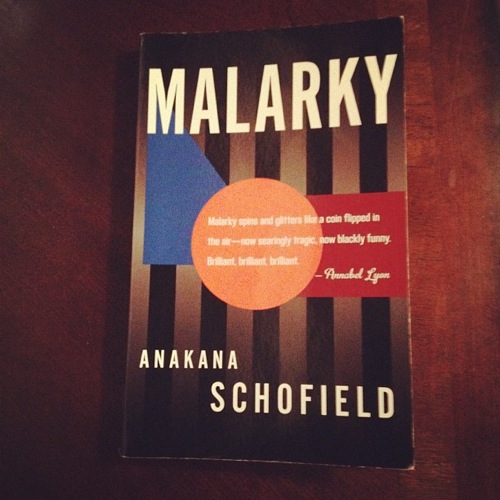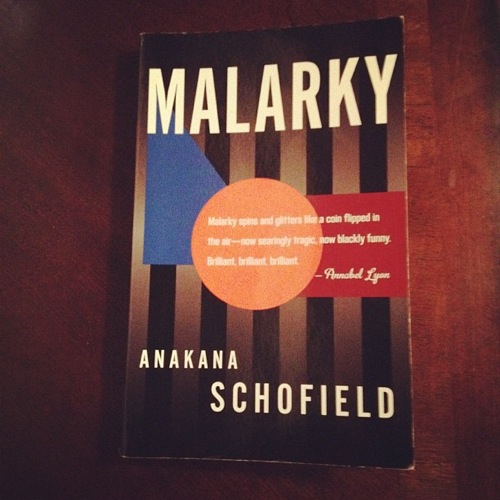
The subject matter of Anakana Schofield’s Malarky is one that appeals to a very specific subset of readers. The novel presents an Irish farmwife’s perspective of marital infidelity and her struggle to accept her son’s homosexuality. Being neither an Irish farmwife, nor (thankfully) having ever been in a situation to deal with marital infidelity, suffice it to say, empathy was not something that abounded within me as I read the work.
But what I can appreciate about Schofield’s novel is how her writing style adds structure and definition to the lead character’s stream of consciousness. The book itself is written non-linearly, in a series of twenty episodes. That is to say, each episode (or chapter) reads like an individual short story, as opposed to each chapter advancing a greater narrative. The disjointed nature of the book places even greater emphasis on Ms. Schofield’s writing abilities. A lesser writer would not hold a reader’s attention for long, but Schofield’s running narration of “Our Woman’s” thoughts makes for an entertaining, thought-provoking read that surpasses the novel’s lack of constancy.
Regarding her peculiar format, Ms. Schofield explains away the method as an attempt at being truer to life:
This structure serves to reflect the nature of a whole life and the act of remembering and to record the fact that we do not remember chronologically. We do not recall necessarily “in sequence,” so I find the chronological unrolling narrative to be a falsehood.
Anakana Schofield, Press Release: Malarky – A Novel in Episodes
Given the author’s caveat, it strikes me as misguided to attempt to analyze the work chronologically, as a book review typically would. To summarize the book would to be to write twenty, separate summaries of each episode – a particularly harrowing prospect for my own readers, I’m sure. I suspect it is a better use of time to provide some thoughts about the work thematically. As I read the novel, three important themes emerged from the twenty episodes, all related to the modern notion of relationship. Specifically, Ms. Schofield seems to communicate that friendships are transient, romantic relationships are often rooted in the transactional, and familial relationships are never very far removed from the lurking specter of grief.
The Transience of Friendships
Regarding the first point, Our Woman lives a relatively atomized existence. Her social circle consists of four or five friends, her husband, and her son. From this network of relationships, the novel traces the breakdown of Our Woman’s friendships following rumors of her husband’s affair, through the actual details of how her marriage became so stagnate as to render the affair unsurprising, and ultimately through Our Woman’s graphic discovery of her son’s sexual orientation.
The result is that her friends make only fleeting, shallow appearances in the novel’s the episodes, rendering the characters less flesh and blood and more like the outlines and caricatures of people. It’s probably giving Schofield too much credit, but the sketch characters remind me of the Bible’s Book of Job where superficial friends berate Job only to lead him askance of God’s purposes in suffering. Similarly, in Malarky, the friends serve as distractions that prevent Our Woman from actually dealing with the various griefs that beset her. Because the friendships aren’t well-developed in the novel, Our Woman exists in a sort of void, forced to deal with her husband’s infidelity and the shock of her son’s sexual orientation without a support network. To wit, when she needs them most, her friends never appear.
Romance as Transaction
The notion of relationship is further muddied in Malarky through Schofield’s treatment of marriage and romantic attachments. Malarky approaches romantic attachment from a transactional perspective, not unlike many other contemporary works of literature and cinema. For example, E.L. James’s Fifty Shades of Grey approaches the relationship between lead characters Christian and Anastasia as a literal contract of consent before the novel delves into the erotic content for which it has become so well-known (not that I would admit to reading it). Similarly, the PBS series Downton Abbey revolves entirely around the transactional nature of marriage and the question of arcane British inheritance rights. In the show, lovers and would-be lovers are constantly haunted by the question of whether they are genuinely interested in on another or simply ‘in it’ for the money.
Given the tired motif of romance as transaction, it was difficult to see what Schofield would add to our collective understanding of the concept in general. Rather than taking readers back into the actual process of relationship as transaction (à la Downton Abbey), Schofield’s work offers a surprising glimpse into the analysis – viz., Schofield offers us a look inside the mind of a woman that is morally torn by the reality and prospect of marital infidelity.
At risk of giving too much away, readers learn early on that Our Woman’s husband has had an affair. What boggles Our Woman’s mind is less the affair itself, than what the proverbial other woman would possibly see in her husband. Schofield writes:
There’s so little to recommend him. And yet a woman has taken him and he has taken this woman and there’s nothing for it, she must investigate the very bones of this transaction. p.45
Our Woman’s revelation is that her marriage had become so routine and lifeless that her husband’s affair is more intriguing than disturbing. The conclusion is a sad one in many respects, but the lack of moral outrage presents an interesting dilemma as Our Woman weighs the actual costs and benefits of whether to have her own affair in return.
Family and Grief
Finally, Ms. Schofield’s work explores the concept of family through her relationships with her husband, and son. It is, of course, telling that both men die early on in the novel. In fact, page one communicates the fact that Our Woman is a widow. But the bigger point Schofield makes through the disclosure of infidelity and the details of Our Woman’s marriage is that the familial bond between husband and wife and already expired for quite some time, long before infidelity was even entered into the equation. Schofield makes the point particularly well as she recounts a conversation between Our Woman and her husband before the two fall asleep:
There was a brief lapse in time between them when she settled into bed that night beside Himself. He stared at the ceiling as thought his eyes are searching for a new planet to rest on, betraying an allergy to the current one. p.57.
The excerpt communicates the husband’s (aka, Himself) obvious desire to be ‘anywhere but here’, as the saying goes. But Schofield’s writing treats the moment as an instance of lament rather than anger. In this subtle way, she transforms one of the book’s major ideas, viz., infidelity, into a synonym for grief. As readers continue in the story, the transition of infidelity into grief becomes even more stark. Schofield’s bold point is that few things in life are more tragic than a couple sharing a bed, while being veritable light years apart.
Schofield’s exploration of Our Woman’s son’s death makes a similar point about grief but in a much more conventional manner. Toward the end of the work, Schofield describes conversations that Our Woman has with “Grief” regarding the death of her son Jimmy – from the inside of a mental ward, no less. Jimmy has long since passed away when Our Woman reveals to Grief that she has conversations with him on a regular basis:
– Jimmy and I had an understanding. And in that understanding he wanted me to tell people only when I was ready.
– And how did you know about this?
– We’ve talked about it, I said. Defeated.
– Do you talk to him regularly?
– As a Matter of fact I do…that was how my husband put me inside the hospital. p.151.
Schofield’s wit makes it difficult not to laugh at Our Woman’s conclusion, despite the gallows humor of the situation. But the not-so-subtle point Schofield makes about Jimmy’s death is that Grief has become too difficult for Our Woman to bear. The remainder of the novel chronicles Our Woman’s downward spiral, and the interesting gaggle of friends she seems to make during her stay in the mental hospital. This aspect of the novel isn’t particularly original in form. Yet, Schofield’s writing as excerpted above does an admirable job of rescuing it from the realm of cliché. To put matters differently, Schofield’s writing is so entertaining as to beg one’s pardon for the overdone theme.
In all, I was pleasantly surprised by Ms. Schofield’s work. The novel used fairly conventional topics to make relatively unique and modern points about our understanding of relationship. Though the structure was a bit difficult to follow, the format was effective in redirecting my attention to Schofield’s writing. For those seeking a simple summer read, the work is certainly no beach read. But given the current state of trade fiction, that’s definitely a good thing.