Tag: Book Reviews

  • Book Review: The Book of Neil

    The Book of Neil

    But for the kindness of my friend Meryl Zagarek (http://www.mzpr.com), it’s quite likely that I would have missed the release of Frank Turner Hollon’s latest novel, The Book of Neil (Publisher: MacAdam/Cage; On Sale: Nov. 16, 2012 ; Cost: $20.00). As a bit of reference, Mr. Hollon is a prolific author of children’s books and short stories, but one who also boasts two novels that have been turned into films (Barry Munday; and Blood and Circumstances, which is currently in production). I think it’s safe to say that Hollon’s novel will not be remembered for its prose, which is at times repetitive and understated. But the novel’s staying power is its exploration of a complex theological question, using an extremely minimalist writing style.

    The theme of Hollon’s novel centers on the proposition of Christ’s return to earth in the age of Facebook and Twitter. Here’s how the press release describes Mr. Hollon’s work:

    In The Book of Neil we are asked to consider what would happen if Jesus returned to earth in 2012, at a time when people are driven by consumption, self-indulgence, and a preoccupation with social media. Are we so cynical that Jesus would be dismissed as just another mentally ill street-preacher?

    The idea is striking because the return of Jesus to Earth is one of the few aspects of Christian theology that mainstream Christianity tends not to debate. These days, our theological and moral disputes tend to include issues like determinism, theodicy, Biblical inerrancy, literalism, gay marriage, abortion and once upon a time questions about stem cell research and the like. But these issues are more on the periphery and clearly not central to the tenants of Christian faith itself (viz., Christ’s return to Earth).

    So, what would it look like if Jesus came back to Earth, say, today? How would the event unfold? What would the reaction of believers be as opposed to the reaction of non-believers? Hollon’s novel offers readers his interpretation of the answer.

    What’s obvious from the first page is that the work is no typical novel. Hollon’s writing style is minimalist to the point of distraction (more on this later). His characters are sketches of what characters should be. The details Hollon provides are sparse. Days bleed into one another without paying heed to the logical progression of time. In this way, Hollon’s work is not a cheap knock off from Joyce, focusing on the minutia of the day to day. Instead Hollon’s style keeps the focus on life’s panorama of the forest. The big picture accented by big themes. 

    The first theme readers encounter is Hollon’s embrace of absurdism, which not only provides the justification for Hollon’s experiment but also paves the way for some of the other ideas explored in the work. Absurdism suggests that human efforts to divine meaning are absurd on their face because the exercise is impossible and doomed to fail. Absurdism’s implausibility of truth justifies the minimalist introduction to the work beginning on page 1 of the novel. There, Neil casually meets Jesus on the 14th hole of the local country club. After exchanging pleasantries, Jesus notes, “You’re probably wondering what I’m doing here.” Without waiting for an answer, Jesus replies:

    “I’m playing golf,” He said. “A frustrating game. I don’t really have the patience for it, but I enjoy playing anyway.” p.11.

    Aside from being a bit presumptuous, Jesus’ opening line in the work is rife with absurdity because of how mundane the introduction actually is. It’s a bit like an off-Broadway production of Seinfeld, a scene about nothing using next to nothing to make the point. Hollon’s early pages make the search for meaning futile because they take place on the blandest of all locales to which the Son of God could possibly return. To make the point even more pronounced, Hollon fills the mouth of God Incarnate with the same, tired clichés about golf uttered by every other hack with a set of clubs.

    This absurdist framework creates a justification for everything that follows. Specifically, Hollon can continue his experiment because it is not a search for meaning. Rather it is an exercise in potentiality, an experiment illustrating what could be. There is no deeper truth to Hollon’s work because it is a hypothetical, and searching for the Truth in a hypothetical is folly because hypotheticals are by definition works of fiction. 

    Of course, the book would be relatively short and uninteresting if page after page of the work recounted the folly of man’s search for meaning set amid scenarios and scenes that have never happened. Almost of necessity, Hollon’s embrace of the absurd requires him to explore the implications of his premise which is by far the more interesting exercise of the novel. This analysis begins with the simple observation that a world void of meaning presents a rather large opening for individuals (and ultimately society) to descend into nihilism. 

    The book’s eponymous anti-hero Neil describes the matter as follows:  

    It’s the never ending balance. On one side is the absolute knowledge that nothing whatsoever matters. There’s nothing any of us can do, nothing, that makes any difference at all. The world will continue to spin, time will continue to run, and each of us, every single one of us, will die, go back into the earth one way or another, and be forgotten in the blink of an eye.

    On the other side, we wake up every morning and convince ourselves how important it is to provide for our children, bring the dog inside when it’s cold, mow the grass, pay the electric bill. And we ignore the irreconcilable differences between the two, the dichotomy. How can we not? Utter hopelessness is only a thought away, and the dogs are at the door. p.123

    If we grant Hollon his absurdist introduction, then Neil’s summary of the matter is the natural result. Throughout the novel, various characters struggle to make sense of Jesus’ return, and invariably this forces them to evaluate the mundane and traumatic in their lives vis-à-vis the hope that life itself is not absurd and void of meaning. Much like he does in the New Testament, the figure of Jesus brings hope to individuals that takes them beyond the nihilistic conclusions of absurdism, and beyond the empty existentialism of crafting a subjective meaning from life’s routine.

    Hollon uses this otherness of Jesus to advance the majority of his novel’s plot. Readers see stories of individuals demonstrating the effects of Jesus’ return on the micro-level. As the scenarios play out in the characters’ lives, this has the effect of rescuing hope from the clutches of the absurd in the novel. Some of the characters find hope and inspiration through Jesus’ return. Others are forced to confront whether they believe in an alternative to nihilism and the existential routine of truth as subjectivity. 

    While the novel is rich in major themes and presents nearly all of them in a sophisticated manner, the emphasis on big picture has the effect of diminishing Hollon’s prose. This is not a novel to read if you long for the descriptions of Tolstoy or the punch of Hemingway. Hollon does not pretend to be anything other than what he is: a thoughtful writer, intrigued by the ideas of his work. But as a result some of his prose suffers. Portions of the novel are repetitive. Phrases, jokes, witticisms all make more appearances than necessary. And to be fair, most of the characters lack depth. We learn little of their backgrounds, aspirations, and even motivations in some instances. But this is deliberate. Prose, character development, and style are all sacrificed for Hollon’s experiment with big concepts. The novel is bold in this regard even though this quality could easily be off-putting to the casual reader. 

    Still, it is Hollon’s boldness that makes the work a success. For all of its faults stylistically, Hollon’s insistence upon exploring big ideas more than makes up for the novel’s ultra-minimalist style. The question going forward will be whether Hollon’s hard work and focus on the forest will find success in a culture and readership that is increasingly more interested in the trees. 
  • Book Review: Judging a Book by Its Lover

    Judging a Book by Its Lover

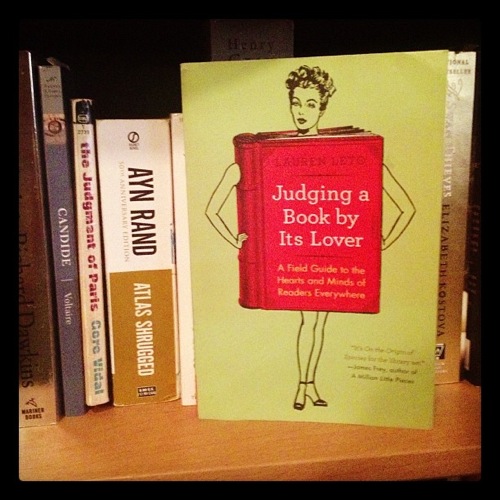
    The press release billed Lauren Leto’s latest book Judging a Book by Its Lover: A Field guide to the Hearts and Minds of Readers Everywhere (Publisher: Harper Perennial; On Sale: October 2, 2012; Cost: $14.99) as a “hilarious and insightful take on contemporary book culture that both celebrates and mock’s literature’s biggest names and the people who read them.” Not being one too shy to mock the inane, I couldn’t help having my interest piqued by Ms. Leto’s work. 

    The only problem was that I had never heard of Lauren Leto.

    A search of the interwebs revealed that she is the co-founder of a website called http://www.textsfromlastnight.com/, which (surprise!) publishes the unfortunate text you wish you had never sent. Besides this, it is worth noting that Leto is also a recovering law student, having dropped out of Wayne State Law School to launch her much more successful ventures on the web. Given this background I couldn’t fault Leto for her life choices but I still didn’t understand what made her particularly qualified to offer “snarky but spot-on observations about books and the passionate conversations they generate,” let alone why the “memorable moments from her own adventures in reading” should be interesting enough to merit a book deal.

    Alas, the press release and author bio offered no answers to my questions. Still, I soldiered on. Intrepid.

    Judging a Book by Its Lover reads like a book title in want of content. To fill the void, Ms. Leto’s every musing about the world of books seems to make it into the text. Early in the book, Leto inevitably describes readers of Ayn Rand novels as “old-money preps” (p.17), while reducing readers of Che Guevara biographies as “quirky hipsters” (which actually sounds about right). I suppose this is an example of Leto’s “distinctive voice” and “sparkling wit” but really it seemed more like an exercise in cliché. Similar misfortunes occur in the chapters titled “Fan Letters” (p.66), where Leto “berates” fans of various authors for their fandom, and “Stereotyping People by Favorite Author” (p.112), where Leto describes, quite pithily, the type of people who read the authors she lists.

    The remainder of the text includes cheeky vignettes on everything from the influence of children’s books on childhood development (Reading Green Eggs and Ham = awesome kids) (p.106), to the surprisingly moving account of the relationship Leto developed with her grandmother, which centered on a common love of the written word (p.262).  

    Despite the relative non-sequitur nature of the essays, the best chapter of the book also comes from its longest chapter titled “How to Fake It.” Readers can be forgiven if the provocative title disappoints. The chapter actually outlines how to “casually discuss some of the most well-known classic and contemporary authors” without having read them (p.127).

    For each author discussed, Leto provides a brief summary of the author’s life and influence, a description of the author’s major works, and a few points of detail about the author’s themes, writing style, etc. Of Dostoyevsky, Leto notes, “Dostoyevsky was exiled to Siberia by the czar because he’s a badass motherfucker.” She then recounts how Dostoyevsky was famously, nearly put to death by firing squad, only to receive a commuted sentence just before the execution was carried out. 

    While I don’t think it’s possible to actually pull off the fake Leto describes, this chapter is interesting because it outlines the style, plots, influences and legacy of a number of well-known authors. Leto’s author summaries, list of major works, and details are all extremely useful for anyone looking to begin exploring a new author, or for anyone in need of a quick-and-dirty book summary. And in all due credit, the sheer number of authors Leto discusses is fairly exhaustive, certifying her as either a true bibliophile or a demented mooch of Wikipedia.

    In fact, Leto’s summaries created a bit of a “To Be Read” (p.259) list for yours truly. Her descriptions of Charles Bukowski’s work sound tempting, particularly when she notes early on that “drinking while reading Bukowski is actually a requirement.” (p.33). Also, her chapter “Infinite Lies” (p.91) actually sparked an interest for me in the works of David Foster Wallace, specifically his book Infinite Jest. This is admittedly, in part, because Leto did not finish it. Imitation is the highest form of flattery.  

    It’s not lost on me that I am being a bit hard on Lauren Leto, though no harder than she was on fans of Ayn Rand (p.66). But to set the record straight, Leto states forthrightly from the very beginning of the book, her admiration for the authors mentioned, and I have to return the same admiration for her. It’s easy to heckle creators from the cheap seats. It’s much more difficult to actually create something that others will want to read. 

    It’s also not lost on me that I’m cracking wise about Leto in much the same way that she snarks about the authors discussed in her book. Of course, I do so with much less panache, much less fame, and a much smaller book deal (viz. none). Though I questioned her authority to opine, I can’t help but admit that I’m in a similar place – with even less authority to criticize books seeing as I’ve never written one. 

    But as Leto notes, this is the essence of what reading inspires. We read to discuss, to connect with others, and to engage those who have read the same story, chapter and words as us. And once we begin this process we all become critics. Some readers are simply better at making their criticisms witty, and compiling enough of them together to make a book. And with that, here’s a hearty congrats to Lauren Leto. 

    Judging a Book by Its Lover will be available to the public beginning October 2, 2012. Pre-order on Amazon here

  • Book Review: The Song of Achilles

    98056828fe2211e1ae7d123138178d5e 7

    While I have not read The Iliad, I would like to think that Madeline Miller has done a great service to those like me, yearning for culture on a time crunch. Miller’s New York Times bestseller The Song of Achilles, recounts the tale of the Trojan Wars from the perspective of Patroclus, Achilles’ closest friend, rumored lover, perhaps both. Miller’s work has been praised as “wildly romantic,” “timeless,” and simply “beautiful,” among many other accolades. Not a bad go of things for a first novel.

    When I began Ms. Miller’s work, I was skeptical at best. My studies of classical works were more or less relegated to the Bible as authorized by God and King James himself. The only classical literature I encountered during my college days was the Cohen brothers retelling of The Odyssey via the bard George Clooney.

    My relative ignorance notwithstanding, I came away from Ms. Miller’s novel with a new appreciation for the ancient themes that make the novel an enduring part of our artistic and cultural fabric. In particular, Miller’s skillful treatment of love and loyalty both merit a brief mention, for these are the things that make merely another retelling of the Iliad a truly memorable event. 

    The key theme that makes the novel work is the relationship Ms. Miller develops between Achilles and Patroclus. From the press release and a few of Patroclus’ descriptions early in the work, it was clear that the relationship would be a sexual one, rather than simply a deep platonic friendship. Typically, I recoil against such reinterpretations of ancient tales. Of late, society’s joie de vivre is to reinterpret nearly every literary relationships between men as gay. From David and Jonathan, to Achilles and Patroclus, to poor Bert and Ernie, men cannot simply be good friends these days. 

    But in The Song of Achilles, Miller makes the schtick work. In fact, were it not for the same-sex relationship, the novel would lose a part of what makes it so compelling – the theme of love. Miller develops the relationship between Achilles and Patroclus quite true to life, in a way that any adolescent relationship develops, awkwardly. From Patroclus’ somewhat creepy leering at Achilles early in the novel (p.26), to the gratuitous comparisons that boys sometimes make in assessing how they have grown (p.94), to the couple’s clumsy first kiss (p.63), Miller finds a way to turn youthful innocence into budding desire without sacrificing the story’s progression.

    To be clear, this is not an easy task. Contrast Miller’s skill with E.I. James’s Fifty Shades of Grey, which is so outlandishly sensual that it makes the plot almost moot. Ms. Miller’s same-sex relationship works, because the novel is about much more than a physical relationship between two men. But the relationship is still essential because it establishes why these two characters’ devotion to one another seems to transcend the rational. 

    In this way, the relationship in the novel must be sexual because love makes us do strange things out of loyalty toward those we love. We see this theme in the novel again and again. The first instance is actually a stirring example of disloyalty on the part of Patroclus’ father. Early in the novel, Patroclus accidentally kills a bully resulting in his prompt exile to Achilles’ Phthia. What’s telling about the father’s act of disloyalty is that rather than explore the facts of his son’s transgression, ensure him a fair trial, let alone show his son any compassion, Patroclus’ father sends him away without a thought. 

    The second important act of loyalty comes when Achilles is sent on a sort of exile himself to train in the arts of war and life with the Centaur King Chiron (p.65). Despite the consequences of leaving the place of his exile, lacking in athletic prowess, and without appropriate equipment for the long trek to Mount Pelion, Patroclus departs the relative comforts of Phthia to join Achilles (p.68). Miller describes Patroclus’ devotion to Achilles as follows:

    I could leave. The thought was sudden, arresting. I had come to the road meaning only to escape to the sea. But the path lay before me, and the mountains. And Achilles. My chest rose and fell rapidly, as if trying to keep pace with my thoughts. I had nothing that belonged to me, not a tunic, not a sandal; they were Peleus’ [Achilles’ father] all. I do not need to pack, even. (p.68).

    And so, Patroclus leaves to find Achilles in the mountains without even a walking stick. I love my wife. I’m devoted and loyal to her. But given my penchant for climate control and wi-fi, I’ve never left our abode to go backpacking in the wilderness on her behalf. The simple lesson of Patroclus’ devotion is that Love begets loyalty and loyalty makes us do strange things. 

    There are, of course, many more examples, but I would rather not spoil Ms. Miller’s retelling of them. The novel reads well, as all good novels should, and these two, enormous themes anchor the book in innumerable, infinitesimal ways, helping to bring the Greek myth back to the present.

    It’s easy to think of acts of love. It is easy to think of acts of loyalty and disloyalty and to recall these thoughts from the annals of our mind. The memories are not always pleasant but they are there. What Ms. Miller does is to help us recall these themes that have helped to forge a civilization, thereby allowing us to reinterpret them in a manner that is as diverse and as subjective as the reader. A tremendous accomplishment. 

  • Book Review Coming Soon

    Once again, I am indebted to my friends at HarperCollins for forwarding an interesting novel my way. I hope to have a review posted within the next week or so. 

    Madeline Miller is a debut author and recent winner of the Orange Prize for Fiction (an award celebrating “excellence, originality and accessibility in women’s writing from throughout the world”). Not a bad go for a first time novelist.

    To students of Greek Mythology (Anyone? Anyone?), Miller’s yarn will be a familiar one. The book, titled The Song of Achilles, is a retelling of the Iliad, which places a special emphasis on the relationship between Patroclus and his Achilles.

    Some may recall that Patroclus was the exiled son of Menoetius. During his exile, Patroclus was raised by Chiron, King of the Centaurs – a king of savages according to Greek Mythology.  By contrast, Achilles was the “golden son” of King Peleus, his mother the Sea Goddess Thetis. The specific element Miller explores is how a relatively awkward “nobody” can strike up such a beautiful friendship with the “best of all the Greeks.”

    In her own words, Miller writes:

    I was fascinated by this man [Patroclus] whose loss had so devastated the great Achilles. I wanted to understand their connection, and why such an “ordinary” man matter so much.

    Seeing as yours truly is perhaps the epitome of ordinary – the Joe Sixpack of Joe Sixpacks – I too am quite curious to see what conclusions Miller draws. As always, more to come.  

    For those interested, The Song of Achilles is available in hardback on Amazon here. It will be released to the public in paperback form by Ecco/HarperCollins on August 28, 2012. 

  • Reconsidering Paris’s Judgment

    The Judgment of Paris - Gore Vidal.jpg

    I never knew much about Gore Vidal, spare his notable row at the 1968 Democratic National Convention with William F. Buckley, Jr., where Buckley threatened to “sock [Vidal] in the goddamn face.”

    Here’s a moment of silence for the death of live TV

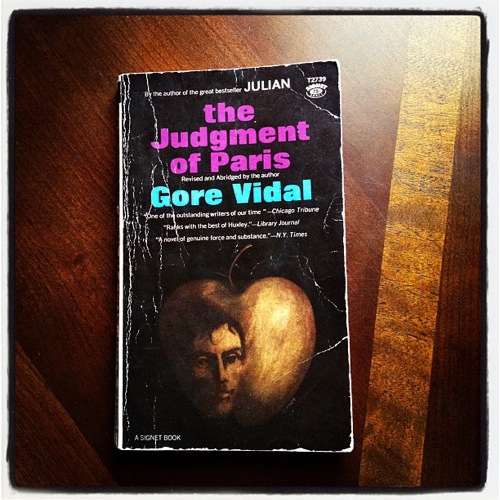
    Naturally, when I heard that Mr. Vidal had himself gone the way of live television a few days ago, I was a bit ashamed that I had not read any of his works, although Buckley dismissed them forthrightly as “perverted, Hollywood-minded prose.” Even so, I decided to rectify the situation by making my way down to the local book seller where I found Mr. Vidal’s “The Judgment of Paris” above. 

    Now, the premise of the book is intriguing in its own right. Vidal sought to add a personal take on the eponymous Greek myth – as opposed to, say, the eponymous website extolling the virtues of plus-sized models. At risk of boring you with too many details, the myth finds Paris judging a celestial beauty pageant between Hera (Queen of the Gods), Athena (Goddess of Wisdom), and Aphrodite (Goddess of Love/Pleasure). Each goddess employs her wiles upon young Paris, making the contest quite fierce indeed. The ultimate winner is Aphrodite who gifts Paris (a mere mortal Trojan) the most beautiful woman in the world, Helen of Sparta. The rest, as they say, is mythology. Helen of Sparta assumes the much more well-known name, Helen of Troy. Thus, begins the Trojan War. Homer writes The Iliad and The Odyssey, and Western Civilization is born. Of course, Western Civilization is subsequently destroyed by the Cohn Brothers’ retelling of The Odyssey in O Brother, Where Art Thou? but that’s a different matter. Call me the man of constant sorrow.

    Anyway, in Vidal’s novel, young Philip Warren is similarly positioned to choose between three women, each of whom in some way mirrors the virtues of the Greek goddesses above. The task proves to be quite the embarrassment of riches for so young a man. First, he is seduced by Regina the arm candy of a major politician who offers him a career in politics and the promise of power. His next encounter is with Sophia a burgeoning academic who catches Warren’s eye but never his lust, as wisdom herself has suffered at the hand of many a man throughout the ages. Finally, Warren meets Anna, yet another married woman, with whom he begins a smoldering affair. 

    Vidal’s resolution of the myth is much less clear than the Greeks’ myth. But the one bit of writing that struck me was the quote from Warren toward the end of the novel as he grapples with the choices he has made over the past year: 

    I find it demoralizing to realize that there is no such thing as future, only a long present…that all acts are essentially meaningless, except of course to one’s self. p.203.

    It may seem strange but I find the obvious nihilism of Vidal’s character to be mildly comforting. To accept life’s transience is really a means by which one may simply live. And perhaps that’s Vidal’s point. Like Paris, we mortals have only this long present, so the best we can do is make a go of things incrementally. Long planning is a farce for there’s no guarantee of a tomorrow let alone tomorrows many years hence. Or as the Greek Goddess Nike might say, “just do it.”

    In all, the story was an interesting spin on an ancient tale that all but solidified Vidal’s stature in my mind as a truly entertaining writer – his political views and literary predilections notwithstanding.