Tag: Living

  • Before and After Workout Exhibit

    The website My Modern Met showcased an interesting art exhibit earlier this week by French photog Sacha Goldberger.

    One half of the layout shows pictures of joggers that have just completed a brisk workout. The second half of the layout shows the same joggers in professional attire, posing in the same light, and manner as they had the week before.

    According to Goldberger, the photos are intended:

    “To show the difference between our natural and brute side versus how we represent ourselves to society,” Goldberger tells us. “The difference was very surprising.”

    [Link]

    Here’s an example of Goldberger’s work, courtesy of My Modern Met.

    Joggingseries3

    Goldberger’s premise isn’t terribly insightful. Everyone presents an image of self to the world around us. But the exhibit is dramatic in that it underscores just how highly constructed the image we present to society actually is. Think about how much of our day is spent maintaining the image we wish to present.

    Your morning shower. A, hopefully, daily ritual to evince good hygiene, and keep one’s bodily odors at bay. Why? So that you and your co-workers can co-exist in relative, cubical harmony.

    The clothes you wear. As one fashion blog put it, the entire fashion industry exists for the sole purpose of producing ‘wearable art.’ I kid you not. They really said that. By this logic, you choose to wear clothes that make an artistic statement about you to the rest of the world. My t-shirt and jeans, for example, probably say to the rest of the world, “I hate you.”

    The car you drive. Chevy struck advertising gold in the early 2000s in its effort to persuade Americans that you are what you drive. While trying to hawk its massive, and over-priced Silverado pick-up trucks, Chevy cleverly implemented the tagline “Like a rock.” Alas, this would be the last clever thing Chevy ever did.

    The point of the “like a rock” campaign was that “you may be a bit soft about the gut, but by God if you drive a Chevy you’re just like a rock all the same.” According to the Wall Street Journal, the “like a rock” campaign was so successful among middle-age men, Chevy just might bring it back. The point, of course, is that the vehicle you drive says something about you to society.

    For example, one good friend, who shall remain nameless, drives a Kia Spectra circa. 2004. His choice of car says to society, “Please, don’t hit me. But if you must hit me, I have lots of insurance.” Yes, my good friend is an attorney. My own, battered Chevy Colorado says, “I decided to start law school in the desert west before the economy tanked, and moved here from a major city where I didn’t need a car. This is all I could afford.”

    The accessories you carry to work. Being but a lowly student, I don’t have a real job per se. But since I am a student, I’ve given considerable thought to the kind of backpack I carry. I think my Timbuk 2 bag tells society, “I could be a hipster, in a real city.” And once society believes what the bag tells them, it says, “I kid, I kid! The limeade racing stripe was supposed to let you in on the joke.”

    Etc.

    I suppose I’ve quite belabored the point by now. But the exhibit really is interesting in that it underscores how nearly the entirety of our waking existence is spent shrouding the image on the left in the trappings of the image on the right. Naturally, this doesn’t address the real question.

    Exactly why do we care so much about what other people think of us?

  • Why I Love America

    American flagA prominent Native American law blog I follow posted a tongue-in-cheek message to Americans celebrating the Fourth of July. The headline declared:

    Happy Fourth from the Merciless Indian Savages

    [Link]

    For the confused, the headlined referenced a brief passage from the Declaration of Independence, listing the offenses of King George III. The excerpt appears in full below:

    He has excited domestic insurrections amongst us, and has endeavoured to bring on the inhabitants of our frontiers, the merciless Indian Savages, whose known rule of warfare, is an undistinguished destruction of all ages, sexes and conditions.

    It’s true that the United States has had a violent relationship with American Indians. From an abject policy of destruction and relocation hailing from the early years of the Jackson Administration, to a policy of systemic termination of tribal governments, I suppose if any group in America has a grievance against the government we celebrate today, it would be my people, the Native Americans.

    The point is not to measure effronteries, but I can understand the purpose in the making the statement. The simple fact is that America is neither a perfect angel, nor an evil villain as the social extremes would suggest.

    The best description we can give America is that we are a wonderful, complicated, dysfunctional family.

    Think about our family tree. We have Bible-beating aunts from the midwest. We have uncles that drink too much from the south. We have mothers and fathers who don’t speak to each other anymore (but refuse to divorce for tax reasons) in the northeast. And we have lazy cousins who would rather be professional students than get a real job from the west.

    But even the most dysfunctional of families has to come together every now and again.

    So, we have an annual probate meeting to discuss the estate of our late Uncle Sam. Each family sends its delegates to the meeting down in Washington, D.C. where they take in the sights, and pretend to be very busy. Being a family meeting, however, you can imagine how little they actually get done. In fact, they spend most of their time yelling at each other, drinking, and having the odd sex scandal. The end result is the occasional bastard child, and the need for years of therapy.

    But sometimes we really do come together, and get important, things, done. This doesn’t happen often, but it does happen on occasion. And when it does happen, we’re a stronger family for it. That is until the next time Uncle John gets drunk watching Nascar, and mocks Cousin James for his vegan lifestyle in San Francisco. Then we have a family World War III and Grandma and Grandpa have to step in and settle things down.

    And that’s why I love America really. We behave just like a family, only on a bigger scale. And even while we may loathe our cousins for being self-righteous, at the end of the day, we would miss them if they weren’t around anymore.

    America’s greatness isn’t the moral high-ground we sometimes claim. And our weakness isn’t that we drive trucks instead of hybrids. America’s greatness is that we manage, somehow, to get along. Mostly.

  • Remembering Hemingway: Fifty Years Later

    ErnestHemingwayFifty years ago today, legendary author Ernest Hemingway committed suicide in a quiet, central-Idaho hamlet. The incident marked an all but perfunctory end to a most remarkable life.

    Hemingway’s memoirs from Paris, for example, published posthumously in 1964, present tales of a poor, American ex-pat living in the City of Light, calling upon historical luminaries such as Gertrude Stein (p.11), Sylvia Beach (p.35), and F. Scott Fitzgerald (p.179).

    Assuming elbow rubbing with people of consequence is not enough to actually make one interesting, Hemingway also fought in both world wars, fished for Marlin in the Caribbean, and hunted grizzly bear in Wyoming. He famously survived one plane crash, three divorces, and still managed to produce seven novels during his lifetime.

    Suffice it to say, Hemingway’s life was enough to make the Dos Equis man look passé. Stay thirsty my friends.

    But the most compelling thing about Hemingway’s memories of Paris, and indeed of his writing generally, was his ability to recount the mundane. At the end of A Movable Feast, Hemingway paid a final tribute to his favorite city. What follows is the final paragraph of the book in full:

    There is never any ending to Paris and the memory of each person who has lived in it differs from that of any other. We always returned to it no matter who we were or how it was changed or with what difficulties, or ease, it could be reached. Paris was always worth it and you received return for whatever you brought to it. But this is how Paris was in the early days when we were very poor and very happy. (p.211)

    To observe the anniversary of Hemingway’s death, Wired.com ran a piece by author Marty Beckerman, exploring what Hemingway would think of our digital age.

    Unsurprisingly, Beckerman’s take is that Hemingway would not think much of the world we’ve created.

    Today, many of us have become rich in the currency of cowardice. We have so many things and so few experiences. We are desperate to live as long as possible, not as large as possible. We are so afraid to say goodbye to the world that we never say hello.

    We are numbed in our high-def, Wi-Fi cocoons, eager for materialistic possessions — the newest, fastest, shiniest gadgets — instead of a fitting end to a life well-lived. If Papa hadn’t killed himself out of despair in 1961, he would kill himself out of disgust today.

    [Link]

    The article is intentionally jarring, and outlandishly funny. But it’s also true.

    Whether due to our technological prowess, or our penchant for comfort, mankind as a lot really isn’t as interesting as our forbearers. Beckerman mocks our affinity for Twitter, and Facebook, but it’s a sad fact that much of my day is spent checking both sites and wondering who is doing the same of mine.

    Beckerman’s solution is to power down the gadgets and get back to the serious business of life – such as stalking prey across the Serengeti, and having real affairs as opposed to digital ones (here’s looking at you Anthony Weiner).

    Aside from the affairs, I’m not sure Beckerman is all that off in his prescription. Life is worth living because of the experiences we create. Given its brevity, there really isn’t anything to be gained by playing it safe at every turn.

    And so, in honor of a man who truly lived, here’s a broad bit of encouragement: do it your way.

    Ask your crush to coffee. Go for the job with the corner office. Finish the novel. Go back to school. Take the vacation you’ve been planning. Email your long-lost friend. Adopt a Pit Bull. Spring for the nice bottle of Scotch.

    And, above all, never, ever drink cheap wine.

    Hemingway wouldn’t have it any other way.

  • Song of the Week: Free the Toronto Nine

    This latest song of the week is an unusual one, brought to you courtesy of the Sylvan Street jazz band, titled Free the Toronto Nine.

    The song is unusual in that I really don’t know much about the Sylvan Street jazz band, and I honestly have no idea who the Toronto Nine are much less any idea as to why they need to be freed. I suppose the title could be a vague reference to the nine people who attended the Toronto Blue Jays’ last home game, in which case all nine need to be set free, indeed.

    Obscure titles aside (is there really any other kind of title for the songs found in jazz albums), I’ll be damned if the music video of the song doesn’t make Tucson seem like a pretty hip place to live. The vid was shot in a number of locations around town, and does a striking job of making Tucson seem like, well, a real city.

    Enjoy!

  • Why I Chose to Cycle

    After many weeks of hemming and hawing, I finally decided to take the plunge and give commuting by bicycle a shot.

    The move is purely pragmatic, so let not your hearts be troubled. I won’t be buying organic or driving a hybrid anytime soon. Neither action will save the planet anyway.

    Photo May 18 2 36 33 PM

    So Why Cycle?

    With gasoline, nigh, $4 per gallon, and but a lone pick up truck between me and the wife, cycling seemed like a reasonably inexpensive alternative form of transportation. Whether this proves true is a separate matter. More on this later.

    I realize that I’m not alone in this regard. According to USA Today, bike sales are booming across the country, while even the fattest, and laziest among us succumb to the evil that is big oil.

    Interestingly, this sales spike translates into only a modest increase in actual cycling. But at least we haven’t gone the way of the Brits. One in six of their poor, little prats can’t ride a bicycle at all. God bless America.

    A second reason I wanted to give cycling the old college try is a matter of simple exercise. After spending the past few weeks on exams, and traveling, it’s safe to say I could stand to “get back in shape” – which is really just a polite way of saying that I need to lose some weight.

    The problem is that I’m generally not fond of exercise. While I am a thumb warrior on Call of Duty (5th prestige!), my L.A. Fitness membership has gone unused since about November. Being the reasonable chap that I am, I figured if I can incorporate exercise/fitness into my routine, then I might be less inclined to hate it. Enter cycling, and my seven mile commute.

    UA Bike Path

    Last, I am curious to see what all the fuss is about. Tucson has dropped a considerable chunk of change on its bicycle infrastructure. But, as Andy Clarke, President of the League of American Bicyclists noted, much of this is used by lycra-clad cyclists, sporting $3,000 bikes. And poor students. Given that my own foray is somewhat by choice (like my lycra-clad friends), and somewhat of necessity (like my colleagues at the U of A), I’m curious to see how friendly Tucson, and its drivers are to cyclists who ride for commuting purposes rather than recreation.

    To be sure, I realize the severe weaknesses of this plan.

    For starters, this is the hottest time of the year to begin two-wheeling around town. In fact, I have it on good authority that there are coals in hell next to the Devil himself (or herself) that are cooler than Tucson is during July.

    Second, I’ve never done this before. Given that local cyclists have annual “Rides of Silence” for cyclists who have been killed by cars, maybe Tucson isn’t the safest place to learn how to commute by bicycle.

    Last, I’m not sure that cycling is actually a less expensive way to get around town. At least not so far.

    But life is what happens while you’re doing something else, and the benefits seem to out weight the costs, so away we go.

    My Bike

    Readers may recall that I had a lengthy dilemma in deciding whether to bike at all (see here, and here), and ultimately a separate dilemma regarding what bike to buy (see here).

    I wanted something that looked vintage and minimalist, that could navigate the hilly terrain near my house, that could handle a 7+ mile commute – all on the budget of a poor graduate student.

    After visits to local bike shops, and BICAS, I discovered that the nice bikes were out of my price range, while the rebuilt bikes did not meet my terrain and distance needs.

    Brief aside, this is really quite a good argument for some entrepreneur to open up a used bike shop, selling refurbished, reasonably priced bikes. I’m not sure I’m that person. But for those looking to make money, the idea is yours, gratis.

    Super Pawn

    In the end, I’m a bit embarrassed to say that my journey took me to Cash America’s Super Pawn Shop where a source from BICAS told me that they had road bikes for sale at half-off.

    The pawn shop seemed a bit sketchy. But, being the cheap bastard that I am, even this did not subsume my desire to find a bargain.

    And, sure enough, I found my bike nestled among a throng of bicycles outside the shop, all marked at half-off. For the curious, they also sell gold!

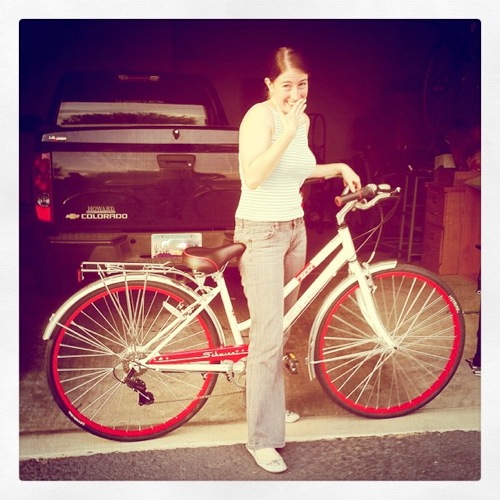
    My steed ended up being a 2009 Schwinn Fastback with Shimano derailleurs and brakes, and a super light, aluminum frame. It cost me all of $67 thanks to the good folks at Super Pawn. The bike normally retails for $432.08 on Amazon, and $499.99 on Ebay, meaning I saved either $365.08 or $432.99 – but who’s counting.

    Schwinn Fastback 2009

    What makes me question the cost effectiveness of cycling, however, is the money I spent getting my bike road-ready.

    I should say from the outset, that I am not complaining about the actual prices. I took my bike immediately from the pawn shop to There and Back Bicycles to let owner Steve Vihel take a shot at fixing it up. Steve did a great job, and charged eminently reasonable prices for all of his services. But the bike just needed lots of fixing up.

    The biggest cost was an Velo Orange Saddle, made of Australian cowhide, with a chrome-plated rail finish. The saddle, its attendant care products, seat cover, seat leash, and the brown bar wrap I bought for the handlebars to match the saddle ran $125.96.

    Saddle model 1 1This was, absolutely, not a necessity. While I settled for a newer road bike, I still wanted something that looked somewhat like a classic, vintage bike. As you can see from the living room photo at the top, I think it turned out quite well.

    The total cost for a mechanical tune-up, and bike maintenance, ended up being less than $200 – and this included the cost of a new tire, tune-up, new cables, new tubes, housing, installation, and labor. I also had two, additional final expenses for a Kryptonite Kryptolok Mini U Lock, and a 7ft Sunlite Cable. After all, it would be a shame to have my bike stolen after all of Steve’s effort.

    My complaint about the cost effectiveness is really about the upfront cost that I had to spend on the bike. The initial purchase was $67, but with the saddle and maintenance factored in, the entire bike ended up costing some $366.99. In sum, my quibble is that the maintenance costs, and upgrades I made were 5x’s the price that I originally paid for the bike.

    But, even this expenditure was less than what I would have paid retail for a brand new Schwinn on Amazon, and a new bike wouldn’t be nearly so cool. Although, I still need to buy a helmet, a mini air pump, extra tubes in case of a flat, and lights.

    Summary

    I’m still pressed to finish my exams, having left in the middle of them to return to Oklahoma and be with my sister last week. So, I hope to take the bike for a proper spin over the weekend – once I acquire a helmet, lights, etc.

    Right now, I’m a little disappointed in the upfront costs associated with cycling. I was elated to spend $67 on the bike. I was less than elated at spending five times that amount to get it road-ready. Maybe I will earn back my investment over time?

    Mostly, I am excited to see what it’s like to commute around Tucson. I’ve spent the past few years mocking cyclists, and the past few weeks trying to learn basic traffic rules for bikes. It’s been quite the turn around.

    I guess I see this going two ways. I’ll either love it – for all of the reasons people love bikes. Or I’ll hate it – for all the reasons people hate bikes. I understand this isn’t terribly insightful. But it does reflect that commuters are rarely ambivalent about sharing the road bicycles.

    I assume this will be a running category of posts, so stay tuned for updates!